
Who pays for resilience? Climate adaptation in the community sector
Climate change is reshaping the conditions for service delivery, making climate resilience essential to good organisational management. Practical tools and sector experience can help organisations get started, while funders and commissioners must support the expertise, time and investment required.
- News
 8 min read
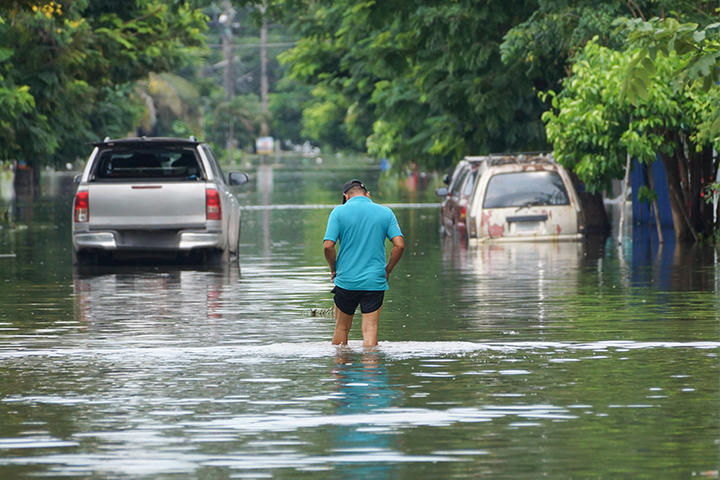
Climate change is one of the most significant and disruptive transitions we face, requiring organisations to adapt – to adjust how they work in response to current and anticipated impacts – while also building longer-term resilience. That is, the capacity to manage disruption, learn and continue serving their communities as conditions change in new and unpredictable ways.
Climate risks do not always fit in neat categories. Rolling heatwaves can cause increased health risks, while also disrupting the transport networks that healthcare workers rely on to reach patients. Floods can damage houses and infrastructure, while making it harder for child protection workers to find safe accommodation for children.
Australia’s first National Climate Risk Assessment reflects this complexity, identifying risks across systems like health and social support, infrastructure, communities, primary industries and food, as well as cross-system risks relating to water security and supply chains. It also highlights the potential for climate impacts to be cascading, compounding and concurrent.1
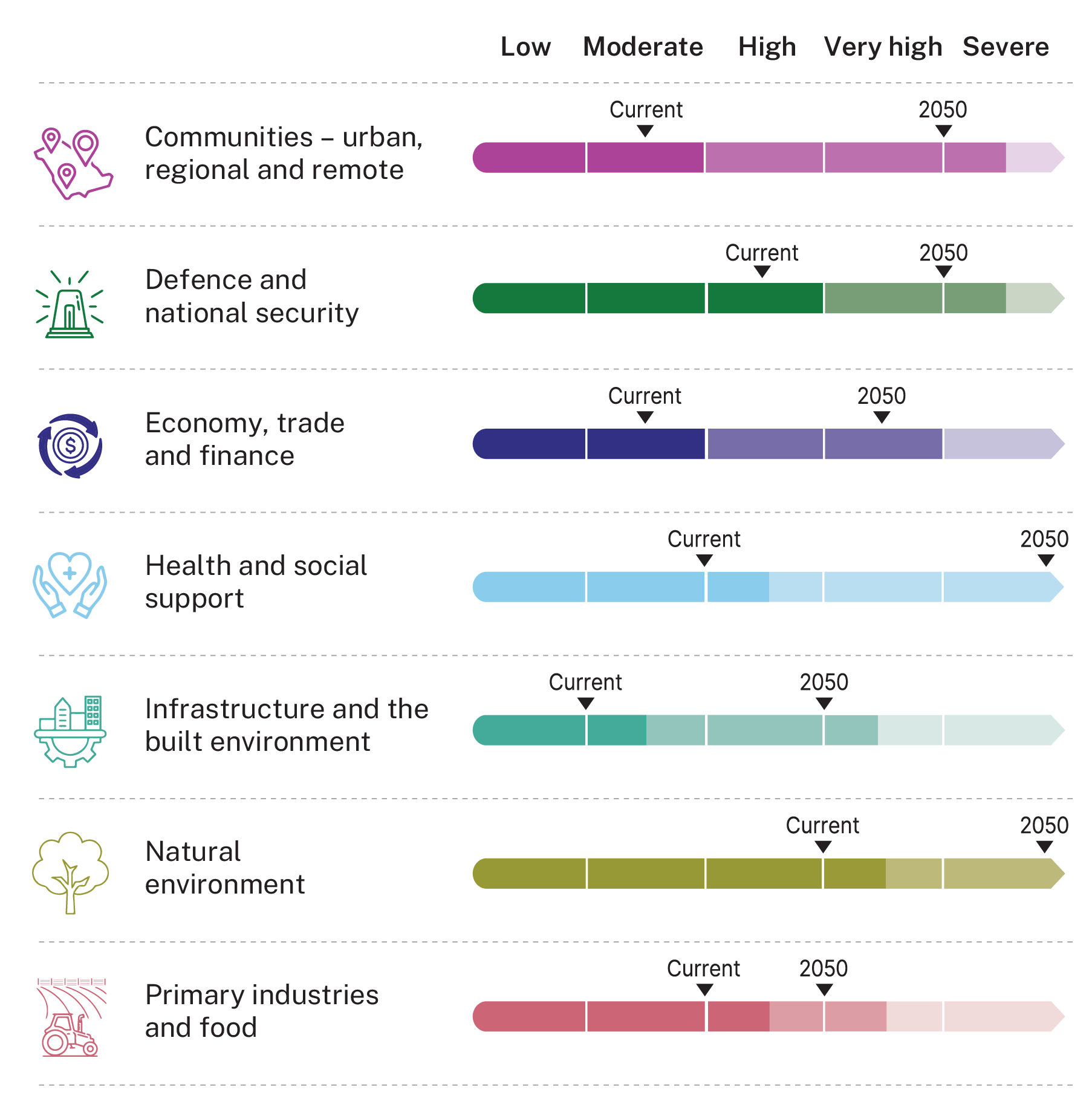
Summary of current and future climate risks – figure adapted from Australia’s National Climate Risk Assessment: An Overview, 2025, pg 17, Australian Climate Service. CC BY 4.0. (https://creativecommons.org/licenses/by/4.0/) Published by the Australian Climate Service. © Commonwealth of Australia, 2025 ISBN: 978-1-925738-98-8.
For community organisations, this is increasingly an organisational and service delivery challenge – not just an environmental one. Most registered charities sit outside Australia’s mandatory climate-reporting regime,2 but this is not a reason for inaction. Instead, understanding and preparing for climate risk should be treated as an operational imperative by both organisational leaders and funders.
Services under pressure when communities need them most
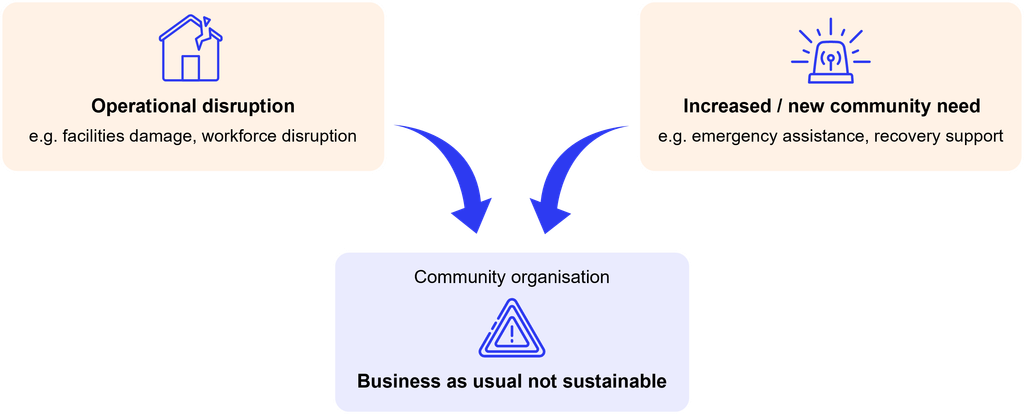
Climate change creates a double exposure for community organisations: Organisations may have to deal with disruptions to their own operations, while there is simultaneously an increase in demand for their services – whether that be emergency assistance or support with longer-term recovery. An organisation’s role might expand too.
NSW Council of Social Services (NCOSS)’s 2026 Community Organisations Disaster Adaptation describes community organisations as consistently among the first to respond to disaster, and the last to leave.3 Despite this vital role, their contribution is not adequately recognised, resourced or embedded within formal disaster-management systems.
Furthermore, as the frequency and severity of these events increases, rising repair and insurance costs could threaten already stretched operational budgets.
This presents a daunting challenge for organisational leaders who often realise that climate impacts belong in their risk registers and business continuity planning but don’t have sufficient funding for in-house or external climate expertise. Understanding what those risks really mean and deciding where to prioritise limited resources to safeguard the organisation can be difficult.
When organisations are in the disaster too
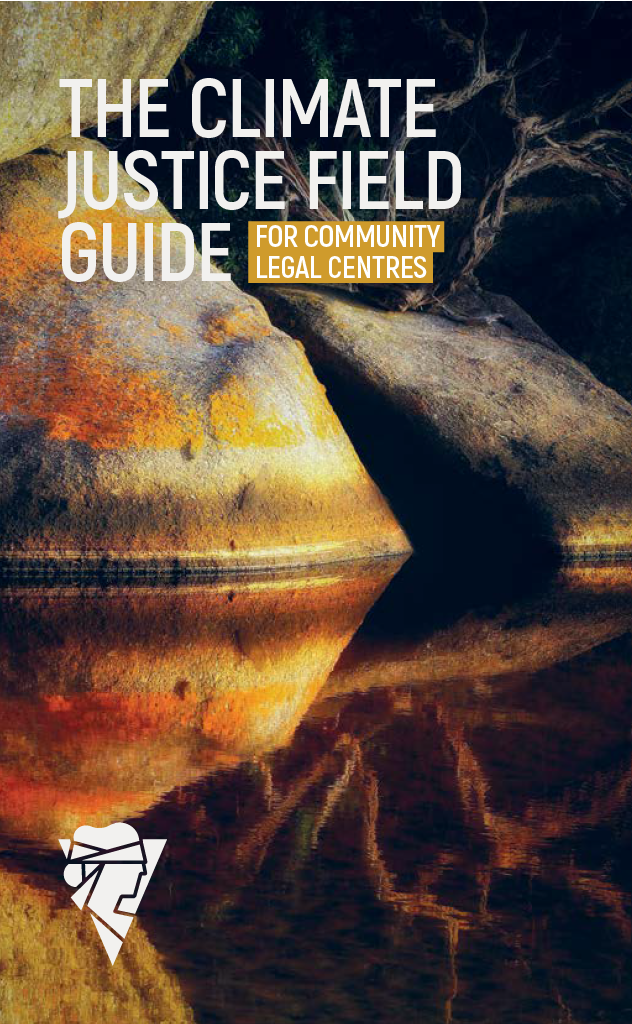
Community Legal Centres (CLCs) are one of many types of organisations already experiencing the dual challenge of climate change disruption. In 2024, SVA supported the Federation of Community Legal Centres with foundational work for its Climate Justice Field Guide, which contains best-practice tools, case studies, theory and practical information to support CLCs to take action.4
The Guide draws on the experiences of community legal centres working in different places and roles, each affected by climate impacts in different ways. One case study describes ARC Justice’s experience of the 2022 Victorian floods – where premises were damaged and staff cut off at the same time that urgent community needs for legal support around housing, emergency payments and insurance claims surged.
Another case study follows the experiences of Hume Riverina Community Legal Service, whose work highlights how climate impacts can intensify everyday legal problems, including those involving housing and financial hardship.
Many community legal centres have now invested in embedding climate justice into their organisational strategy. This means that they are better equipped to respond to changing community needs while also safeguarding their operations to climate impacts. When climate-related disasters strike again, they will be ready to provide timely, useful information thus strengthening the resilience of their communities as a whole.5
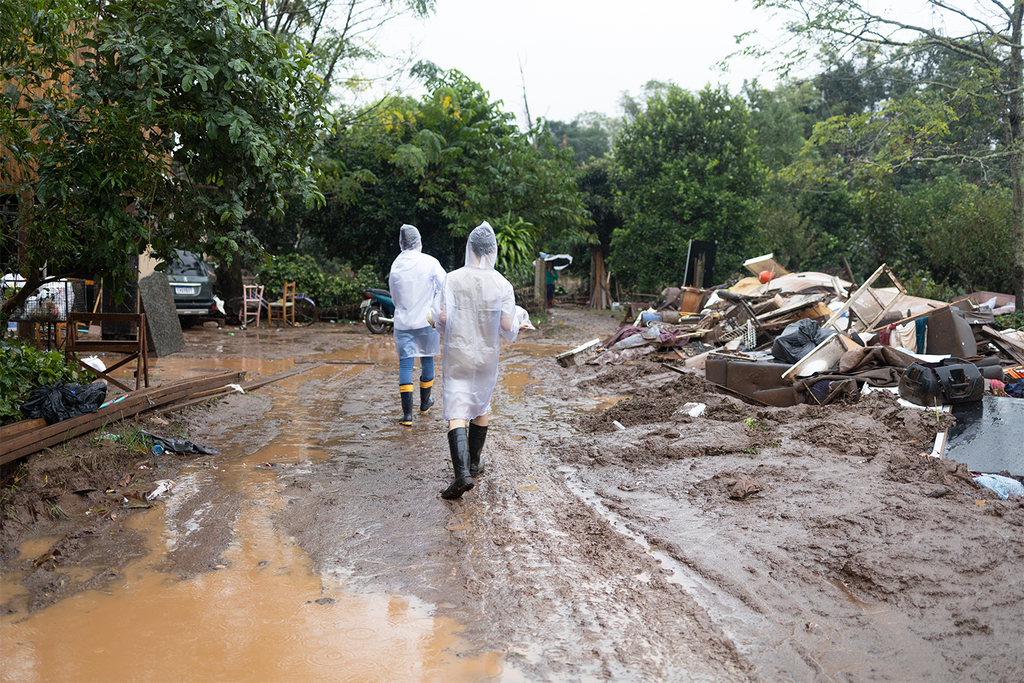
The stories within the Climate Justice Field Guide highlight how sector organisations can come together to learn, adapt and coordinate responses to climate impacts.
Turning experience into shared capability
Other sector leaders are working to translate climate science and lived experience into practical guidance that helps community organisations build adaptation plans tailored to their unique risks and circumstances.
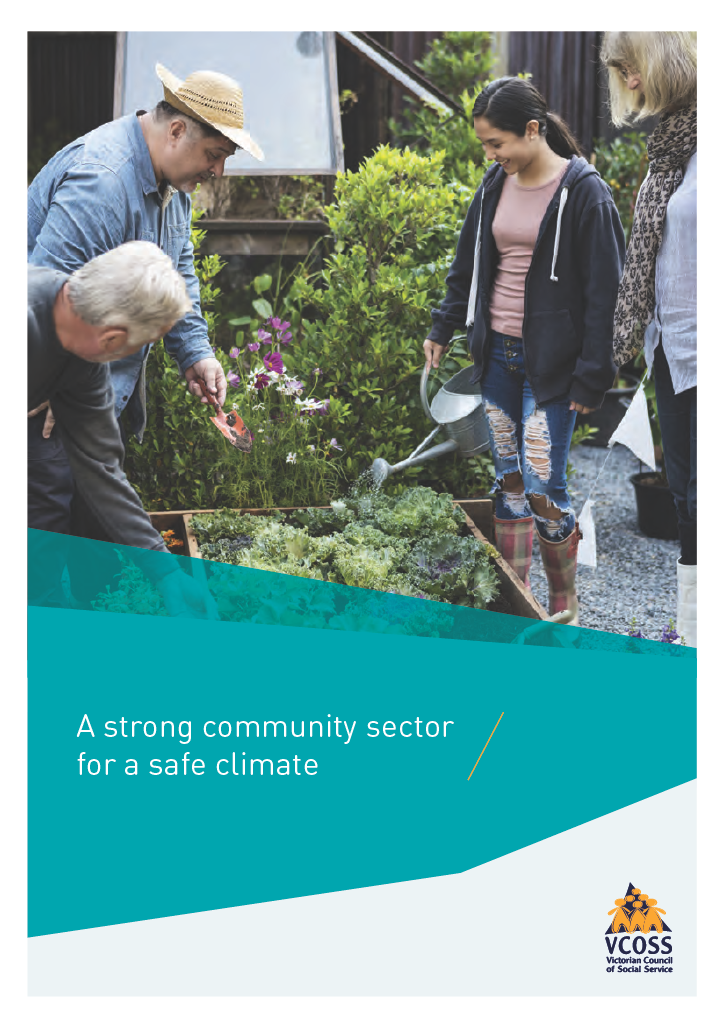
- The Victorian Council of Social Service’s (VCOSS) Climate Network for Community Organisations gives organisations a forum to exchange knowledge, learn from external experts and explore climate mitigation, adaptation and climate justice.6 Importantly, the network extends beyond disaster preparation to the day-to-day impacts of climate change, helping organisations consider how they can prepare themselves, their clients and their communities.
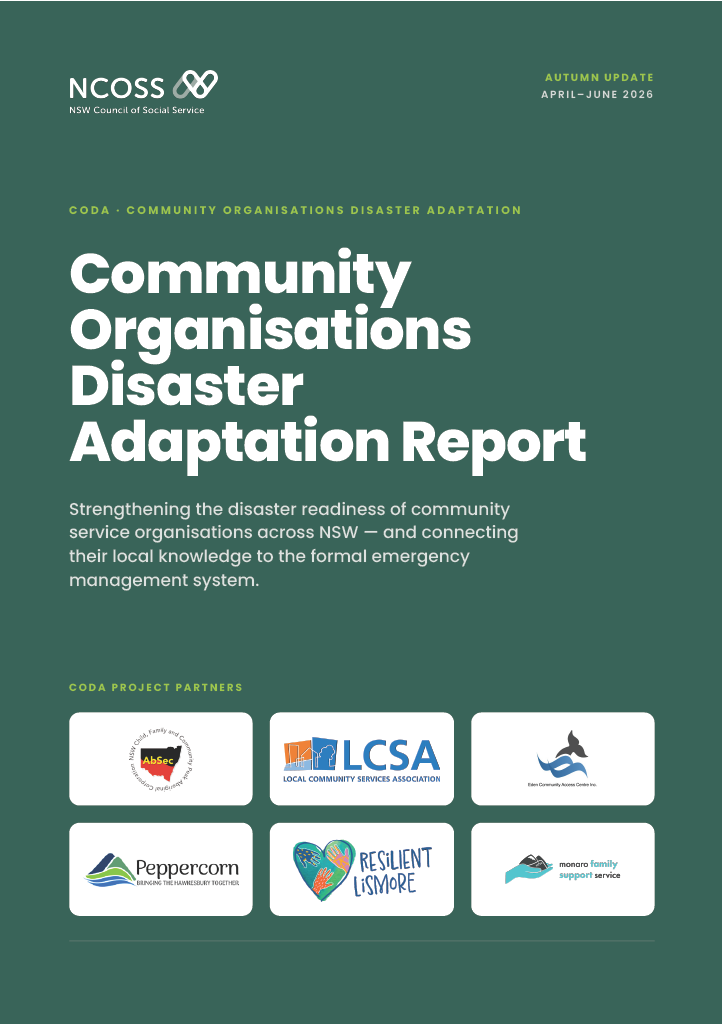
- In NSW, NCOSS is demonstrating how community capability can connect with formal disaster-management systems. Its Community Organisations Disaster Adaptation project is building a bridge between organisational readiness, local knowledge and external emergency management.7 Place-based partners are helping community organisations strengthen business continuity by taking preparedness into interagency forums and connecting their knowledge of community vulnerability with formal emergency management.
- ACTCOSS is piloting an approach that also funds organisations to assess their climate risks and develop an adaptation plan.
- In Western Australia, WACOSS has led the Heat Vulnerability Project which brings together climate, health and community expertise to identify risks and co-design local responses.
This sector leadership is vitally important.
It is also crucial that organisations can translate this information into the required internal changes, decide which actions to prioritise first and develop realistic implementation plans.
Our experience in organisational strategy shows that this decision-making process is often the hardest part. Having effective tools can help structure this process – though dedicated time, capability and resources are still crucial.
Start with existing tools, then bring the right expertise together to make effective decisions
Organisations do not need to start from scratch. ACOSS’s Resilient Community Organisations toolkit offers a strong and intentionally practical foundation. Its benchmarking tool and six-step process cover leadership, networks, risk identification, risk management, preparing people, and continuous learning. It was designed for a time-poor, under-resourced sector and aims to weave preparedness into business as usual rather than create another onerous system.8
For many organisations, these resources are exactly what is needed to begin the process. For some, applying the toolkit will expose questions that they cannot answer internally. For a housing provider, there may be a need to understand heat, energy reliability and building performance; for a food-relief service, supply chains, refrigeration, transport and changing demand; and for a disability organisation, the needs of clients who rely on electricity, accessible transport or regular in-person support.
These questions may require different kinds of expertise. Climate and technical specialists can help interpret hazards and cascading risks across energy, water, transport, communications, buildings and supply chains. Staff and leaders understand the organisation’s services, workforce, finances and critical dependencies. Communities know which impacts are already being felt and which responses will work best in their unique local context. Other actors, such as insurers, may also have a role to play in helping to identify risks and potential mitigations.
The challenge for many organisational leaders will be to bring together these different forms of expertise into meaningful, practical decisions that support resilience.

Community-led adaptation in practice
A 2026 report from VCOSS, Community-led climate adaptation: Case studies from Victorian communities shows how organisations across diverse settings are already embedding climate adaptation into their work. Banksia Gardens combined youth engagement with action on urban heat, while Wellsprings for Women and Enliven Victoria worked with multicultural communities to co-design locally relevant climate-resilience and heat-health initiatives.9 We can see from these examples that climate adaptation will look different depending on the place, people and risks involved. Existing community relationships and strengths provide the foundation for adaptation.
The same idea is evident in First Nations led climate work. For example, The Indigenous Peoples’ Organisation-Australia’s Indigenous Decision-Making Workshop brought Aboriginal, Torres Strait Islander and Pacific representatives together with climate and environmental specialists to explore marine management, drought resilience, and place-based water and food security. The process generated 16 community-determined climate projects, with further work to develop business cases and attract resources for locally defined solutions.10
Specialist expertise and community-led decision-making are crucial to supporting self-determined local solutions. This is particularly important in remote First Nations communities, where climate risks may not be fully captured in broad climate risk assessments.
Turning community-led plans into action will require dedicated funding. That funding will need to come from dedicated domestic investment, because Australian communities – even those highly vulnerable to climate risk – are generally ineligible for international adaptation funds which are reserved for developing countries.
Funders and commissioners need to fund resilience
The examples above show organisations identifying risks and developing local responses. However, there is still the question of how to fund the time, expertise and changes needed to make that work part of everyday service delivery
SVA and the Centre for Social Impact’s Paying what it takes research, supported by Philanthropy Australia, found that the not-for-profits studied had average indirect costs of 33% of total expenses,11 yet routinely under-reported them based on assumptions about what funders would accept. Climate resilience is emerging as another essential capability that organisations must absorb, often without corresponding investment.
Funding arrangements may also need to work differently during disruption. A provider contracted for particular outputs may instead spend weeks locating vulnerable clients, sharing emergency information or coordinating recovery – creating enormous value while falling behind on business-as-usual measures. More flexible and relational approaches to contracting may be needed. You can read SVA’s recent Insights article, Bringing relational contracting to life, for more on how shared objectives, adaptive delivery and joint decision-making can operate in practice.12
Funders and commissioners can start by asking organisations what climate risks threaten continuity of service, what it would take to act on those risks and where existing agreements would limit a response during disruption.
Climate resilience requires action now
The resilience of Australia’s community sector will require action at multiple levels – enabled by effective funding and resourcing.
For community organisations, climate resilience needs to become part of ordinary strategy, risk management and operational planning. Organisations can start with the tools available today to understand the most material risks and incorporate specialist advice and lived experience to build tailored solutions.
For funders and commissioners, resilience work must be funded. Building organisational capability, accessing appropriate expertise and implementing resilience plans all requires resources. Funding arrangements also need sufficient flexibility for organisations to adapt when climate disruption changes community needs.
Community organisations are already showing what resilience planning can look like in practice, bringing together technical expertise, organisational knowledge and lived experience. The task now is to make this work more widespread and turn promising practice into enduring organisational and system capability.
Notes
1 Australian Climate Service, National Climate Risk Assessment, Australian Government Department of Climate Change, Energy, the Environment and Water, 2025, accessed 2 October 2026.
2 Australia’s mandatory sustainability reporting began in 2025 and is being phased in for eligible entities through 2027. It covers climate risks and resilience as well as emissions. Registered charities without annual financial-reporting obligations under Chapter 2M of the Corporations Act are outside the regime. See ASIC’s sustainability-reporting overview.
3 NSW Council of Social Service (NCOSS), Community Organisations Disaster Adaptation Report 2026, NCOSS, 2026, accessed 2 October 2026.
4 Federation of Community Legal Centres, Climate Justice Field Guide for Community Legal Centres, Federation of Community Legal Centres (Vic) Inc., 2025, accessed 2 October 2026.
5 See note 4.
6 Victorian Council of Social Service (VCOSS), Climate Network for Community Organisations, accessed 2 October 2026.
7 See note 3.
8 Australian Council of Social Service, Resilient Community Organisations toolkit, accessed 2 October 2026.
9 J Tice, Community-led climate adaptation: Case studies from Victorian communities, Victorian Council of Social Service, 2026, accessed 2 October 2026.
10 Indigenous Peoples’ Organisation-Australia, Climate Advocacy: Indigenous Decision Making Workshop. accessed 2 October 2026.
11 SVA & the Centre for Social Impact, Paying what it takes: funding indirect cost to create long-term impact, SVA, 2022, accessed 2 October 2026.
12 P Bollen, Bringing relational contracting to life, SVA Insights, SVA, 11 May 2026, accessed 2 October 2026.
Written by

Share this article


Copied to clipboard

Contact the author
If you’re interested in discussing climate resiience and preparedness, get in touch with Hanna Cihal in our consulting team.
Related information




First Nations peoples should be aware that this website may contain the images, voices or names of people who have passed away.