
Bringing relational contracting to life
Sharing our experience with the Resolve Social Benefit Bond to help commissioners understand what relational contracting looks like when taken from concept to delivery.
- News
 7 min read
Recent commentary on relational contracting reflects growing recognition that traditional, highly specified contracts struggle to deliver outcomes in complex service systems. Through our experience with outcomes-based contracts and social impact bonds across Australia, we have seen first-hand how relational contracting principles play out in practice – including where these principles are already embedded within outcomes-based contracts, and where tensions emerge.
This article draws on our experience through the Resolve Social Benefit Bond (SBB) to help commissioners understand what relational contracting looks like when taken from concept to delivery.
What was the Resolve SBB?
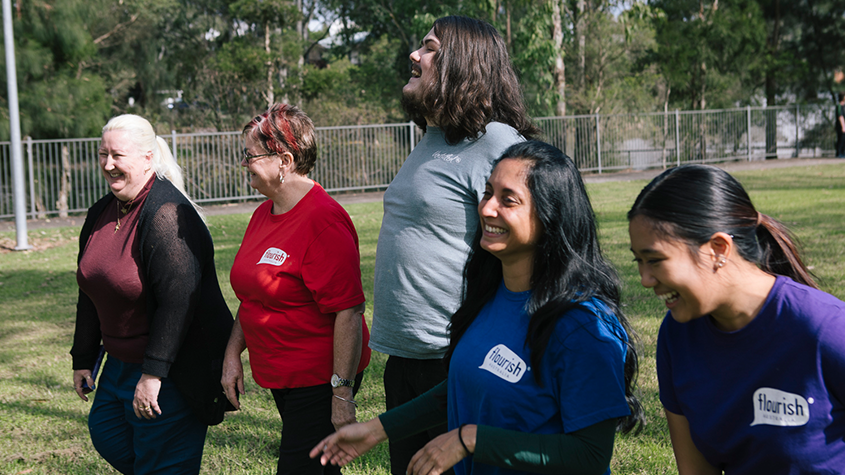
From 2017-2024, the Resolve SBB funded the Resolve program, a psychosocial recovery-oriented community support program delivered by Flourish Australia in NSW.
Resolve supported 469 individuals who had spent significant time as a mental health hospital inpatient prior to their enrolment in Resolve. Over half of participants had a diagnosis of schizophrenia or another type of psychosis, with each participant spending almost 90 days in hospital on average in the year prior to their enrolment. Participants used almost two-thirds less health services compared to the year prior to their enrolment, and experienced reductions in their average lengths of stay in hospital (26%), their overall time spent in hospital (66%) and the rate at which they present to emergency departments (36%).
Partners included the Western NSW and Nepean Blue Mountains LHDs, NSW Ministry of Health, NSW Office of Social Impact Investment and SVA. Learn more about the Resolve SBB here.
Why is everyone talking about relational contracting?
The Australian Government – through the Department of Social Services – has signalled a commitment to pilot relational contracting approaches.1 These trials are intended to move away from activity-focused, compliance‑heavy contracting towards flexible arrangements that support trust-based partnership, shared goals and long-term outcomes.
In this context, relational contracting is not the absence of formal agreements, but a deliberate choice to design contracts, governance and assurance processes that support collaboration and flexibility, while meeting public accountability requirements. For commissioners, this raises practical questions: What does this look like in practice? What needs to be designed differently?
What is relational contracting?
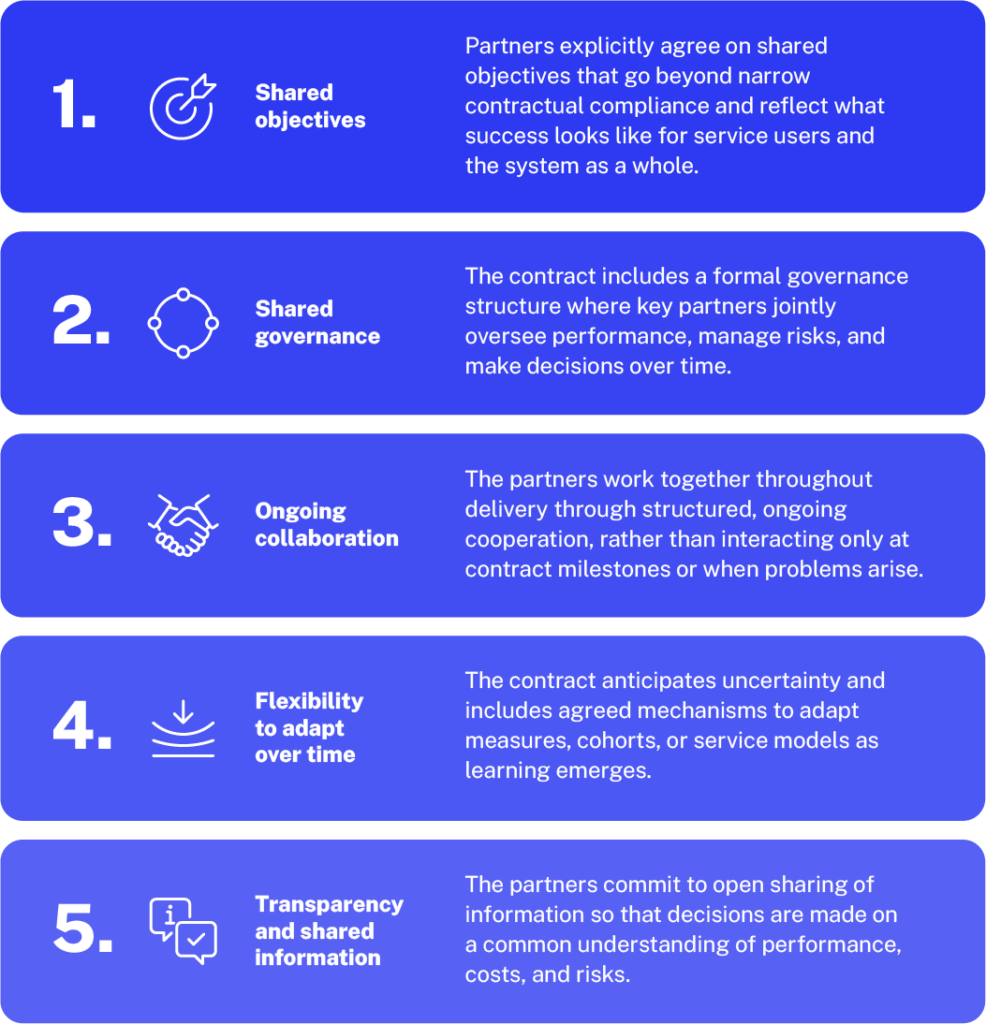
Relational contracting is defined ‘as specific legal agreements between a purchaser and a service provider where governance rules and processes promote cooperation between the parties and prioritise flexibility to achieve the best outcomes.’2
In simple terms, it can be characterised through five features:
Like all commissioning approaches, relational contracting is not universally appropriate and requires specific conditions, capabilities and intent to be effective.
Outcomes-based contracting: alignment and tensions with relational contracting
Social impact bonds (SIBs) are underpinned by outcomes‑based contracts, which are designed to sharpen accountability for results by linking payments to measured outcomes. In principle, this focus on outcomes aligns well with relational contracting’s emphasis on shared objectives and learning.
Relational contracting focuses on how commissioners and service providers work together over time, rather than creating a new funding model. Many outcomes-based contracts have already incorporated these features in practice, even if they haven’t been labelled ‘relational contracting’.
In practice, outcomes-based contracts can also introduce tensions that commissioners need to actively manage. For example:
- Outcomes-based contracts often require outcome measures to be set upfront to support payments. In complex or new services, these measures may only become clear over time, and if contracts don’t allow review with the possibility of revision, this can limit flexibility and misalign incentives.
- Strong payment incentives can shift attention towards metric performance over broader system learning if governance arrangements are not deliberately designed to counterbalance this.
The Resolve SBB experience is instructive because, while it was not designed explicitly as a relational contract, its governance and operating arrangements were consistent with features of relational contracting. This enabled the partners to retain outcome accountability while still adapting service models, targets and even outcome metrics in response to emerging evidence.
Other outcomes‑based contracts, such as mainstream employment services (e.g. Workforce Australia), also link payments to outcomes but are typically designed around standardised performance measures and more arm’s‑length relationships. These models often allow less scope for the shared governance, adaptation and collaboration central to relational contracting.
How did Resolve operationalise relational contracting principles?
The sections below illustrate how relational contracting worked in practice with the Resolve SBB, drawing on insights that emerged through program governance and joint problem-solving with the Resolve partners. For each feature, we describe how it was operationalised and highlight a short commissioner takeaway for commissioning practices more broadly.
Across all five features, a consistent theme was the need for commissioners and service providers to invest sustained effort and build trust over the life of the program, rather than relying on contract settings alone to drive outcomes.
1. Shared objectives
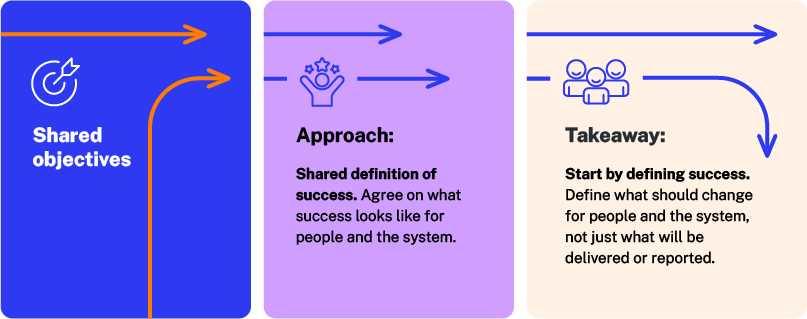
Resolve was commissioned around the shared objective of improving participants’ mental health and recovery. The contract explicitly framed success in terms of improved recovery and stability for participants, reflected in reduced reliance on acute health services. Learnings were intended to inform broader mental health policy and service system improvement.
The objectives of the contract went beyond narrow contractual compliance or service outputs and reflected a shared view of what success looks like for participants and the system.
Commissioner takeaway: Effective commissioning starts by agreeing what success looks like for people and the system – not just what will be delivered or reported.
2. Shared governance
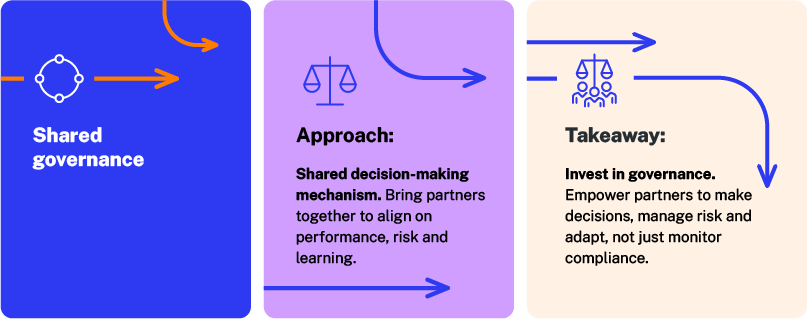
Resolve was governed through formal, multi-party governance structures, including a Joint Working Group and other governance forums attended by government, service providers, referral partners, and funders. These groups jointly reviewed performance, examined outcomes data, considered policy changes, and made decisions about program and contractual adjustments over time.
Governance was not limited to contract oversight or assurance. Instead, it functioned as a shared decision‑making mechanism, aligning partners around performance, risk, and learning. For example, when the original outcome metric didn’t work well for payments, the partners agreed to change it, while still using it to learn what was working. Similarly, shared financial oversight enabled underspends to be transparently identified and reinvested to improve outcomes, rather than treated as a compliance issue.
Commissioner takeaway: Relational contracts require investing in governance that can make decisions, manage risk, and adapt – not just monitor compliance.
3. Ongoing collaboration
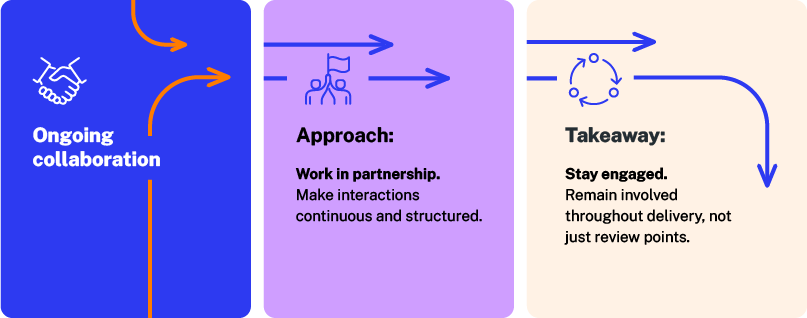
The commissioner-provider relationship was consistently described as a ‘partnership approach’, with the partners working together throughout delivery to identify issues, test solutions, and improve performance. The Joint Working Group met quarterly, alongside more frequent operational discussions between relevant Resolve partners to work through referral volumes and processes, service delivery issues and contractual questions as they arose – for example, when referral targets were not being met early in the program.
After contracts were signed in 2017, interactions between partners were continuous and structured, rather than concentrated around formal reporting or compliance. Collaboration became the primary mechanism for addressing challenges, including early under‑performance and system‑wide disruptions such as COVID‑19 where partners met more frequently.
Commissioner takeaway: In complex services, performance improves when commissioners stay actively engaged as partners throughout delivery, not just at review points.
4. Flexibility to adapt over time
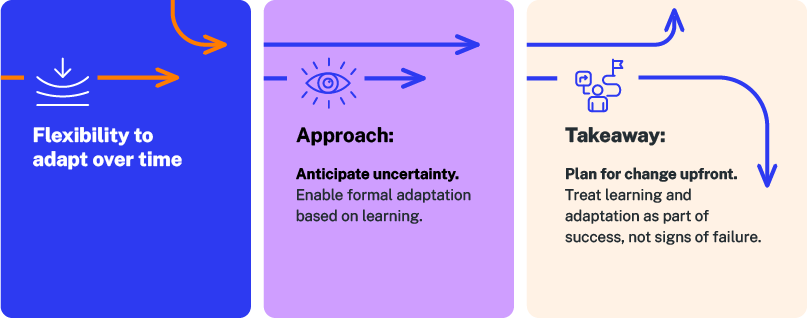
The Resolve contracting arrangements explicitly included review points and mechanisms to adapt both service delivery and contractual settings. When early outcomes were tracking below plan, the partners jointly implemented operational and contractual changes to improve performance, including adapting the outcome payment metric when the original matched control group approach proved unsuitable for payment purposes, while retaining it for learning.
Adaptation also occurred in other areas over the life of the program. Governance discussions identified declining numbers of eligible participants within the original catchment areas, leading the partners to agree to expand the program into an additional regional city and introduce a dedicated peer worker role there to increase access. Learning over time also informed changes to the service and workforce model, including the creation of specialist transition worker roles; the development of structured Learning to Be groups to support recovery-focused capacity building; and using brokerage funding in more targeted ways to better support participants’ recovery goals (e.g. purchasing a camera for a participant so they could enrol in a graphic arts course).
The contract anticipated uncertainty and enabled formal adaptation based on learning, rather than treating any under‑performance as a trigger for sanction or exit.
Commissioner takeaway: Good contracts plan for change upfront, so learning and adaptation are treated as part of success rather than signs of failure.
5. Transparency and shared information
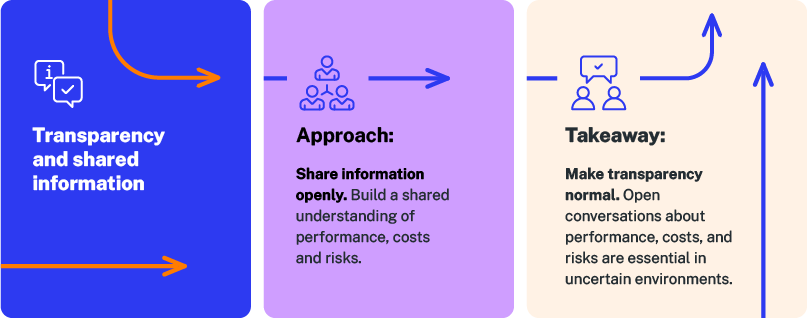
Resolve relied on regular sharing of outcomes, activity, and cost‑related information across all project partners. Activity data, independent evaluation findings, and linked administrative data were reviewed collectively through governance forums.
Transparency around planned and actual stays at the Resolve residential service, and around costs, informed discussions about service delivery models in the pursuit of outcomes.
Information was shared to support joint understanding, learning, and decision‑making, rather than solely to validate payments or enforce compliance.
Commissioner takeaway: Shared data and open conversations about performance, costs, and risks are essential for informed decision‑making in uncertain environments.
So what should government commissioning look like?
As with any approach, relational contracting brings both opportunities and limitations, and requires deliberate design, capability and intent to be effective. It does not, on its own, address structural issues such as short-term funding cycles, lack of indexation, or funding the costs associated with exiting and transitioning services.
Based on our experience, relational contracting is most likely to be effective where there is a genuine commitment to partnership and aligned interests, a stable base level of funding that supports delivery, and long-term funding parameters that allow relationships, learning and workforce capability to develop. It is therefore better suited to long-term commissioning in complex service systems than short-term responses, such as disaster recovery, where different contractual approaches may be required.
We welcome conversations with commissioners and service providers considering how relational and outcomes-based contracting approaches can help deliver better outcomes. Contact us.
This article draws on SVA’s experience as intermediary on the Resolve SBB and reflects learnings developed through collaboration with Flourish Australia and NSW Government partners involved in the program.
Notes
1 Australian Government, Department of Social Services (DSS), A new approach to programs for families and children: Discussion paper, DSS, Nov 2025, accessed 1 May 2026.
2 Prof Considine M and Prof Bonyhady B, Collaborative commissioning and formal relational contracting, University of Melbourne, September 2025, accessed 1 May 2026.
Written by

Share this article


Copied to clipboard
Related information





First Nations peoples should be aware that this website may contain the images, voices or names of people who have passed away.