The workforce barriers employers don’t always see
SVA’s Employer Innovation Lab brought employers from across Melbourne’s West together to explore workforce challenges and identify ways to ensure more young people can access quality jobs.
- News
 4 min read
For organisations facing hiring challenges, workforce shortages, current and future skills needs, there is a familiar temptation when identifying employment barriers for early career workers: to focus on the individual. Do young people have the right skills? Are they work-ready? Do they understand workplace expectations?
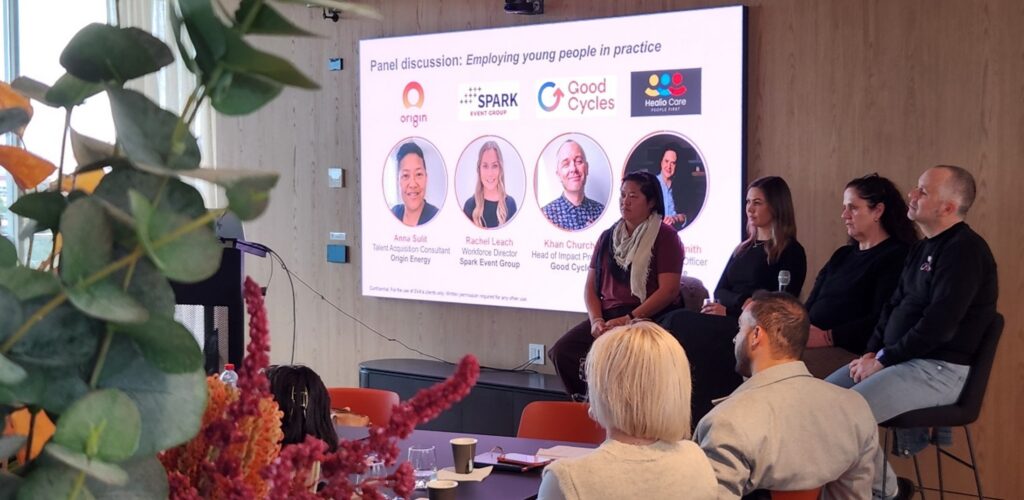
At the Employer Innovation Lab workshop, an expert panel featuring employers from local government, disability services, major events, and social enterprise offered a different perspective. Their experiences suggested that the greatest barriers are often not a lack of talent, but the way organisations recruit, onboard and support people once they join their workforce.
The discussion drew on the experiences of the panellists in creating quality jobs for young people and challenged employers to look beyond individual capability and examine their workplace systems. They encouraged a shift in thinking beyond ways to prepare young people for work, to how workplaces can better recognise potential, remove unnecessary barriers and create the conditions for people to succeed.
Sometimes the process is the barrier
Anna Sulit, Talent Acquisition Consultant Origin Energy
Before joining Origin Energy, Anna Sulit led workforce initiatives at Whitehorse City Council, where she worked with colleagues to examine how recruitment processes were shaping access to employment opportunities.
As part of the Employer Innovation Lab, the Council reviewed long-standing recruitment practices, rewriting position descriptions, redesigning assessment methods and challenging traditional application requirements. The focus shifted from measuring previous experience to identifying potential and removing barriers that may have been excluding capable candidates.
“Some of the barriers that we were putting in front of ourselves were getting in the way of reaching the talent we were looking for.”
The work prompted broader conversations about why certain recruitment practices existed in the first place and whether they were still serving the organisation and the community’s needs.
“A lot of this was because that’s always been the way that we’ve done things.”
The changes helped address workforce shortages across customer service, horticulture and early years services, while creating stronger local partnerships and pathways for local young people to enter the workforce.
For Sulit, one of the most important lessons was recognising that many barriers were embedded in organisational systems rather than individual capability.
When lacking confidence becomes a barrier
Rachel Leach, Workforce Director, Spark Event Group
For Rachel Leach, Workforce Director at Spark Event Group, one of the biggest barriers to inclusion was not policy or process, it was confidence.
As the organisation worked to remove barriers and create more opportunities for young people with disability, managers and supervisors were often hesitant to engage in conversations about disability, worried they might say the wrong thing. The result was not exclusion by design, but hesitancy driven by uncertainty
“We were too scared to talk about it out of fear of saying the wrong thing.”
The shift came when teams stopped viewing inclusion as a test of expertise and started treating it as a learning process. Through training, open conversations and a greater understanding of workplace adjustments, leaders became more confident in supporting young people and creating accessible pathways into employment.
“We keep telling everyone, they don’t have to be perfect. They just need to try and take those first steps.”
By creating a workplace that was inclusive and encouraged conversations about workplace accommodations, existing staff also felt more comfortable in speaking up which created benefits across Spark’s workforce.
Moving from recruitment to retention
Carolynne Smith, Chief Executive Officer, HealioCare
HealioCare brought a provider perspective to the panel discussion. As an NDIS-registered provider operating across regional Victoria and Melbourne’s West, the organisation has seen growing demand for disability support services and has had to rethink traditional workforce models.
“We need to look outside old models and actually get young people in to support young people”
During the panel, Smith challenged another common workforce assumption: that recruitment is the hardest part of the equation. Instead, she reflected that retention, workplace readiness and ongoing support are where much of the real work begins.
Drawing on HealioCare’s experience, Smith highlighted the difference between capability and support. Challenges that are often viewed as performance issues can frequently be traced back to gaps in preparation, onboarding or workplace support.
“We will never send anybody into somebody’s home cold,” she said, describing the organisation’s approach to preparing and supporting new workers.
That people-centred approach extends to workforce participation. HealioCare has built flexibility into its model to help more people enter and remain in employment.
“It doesn’t matter whether they’ve got two hours’ availability or 24/7 availability, we will always try and find them work.”
Small changes can have a big impact
Khan Churchill, Head of Impact Programs at Good Cycles
Khan Churchill encouraged employers to look beyond individual jobseekers and examine the systems surrounding them.
Good Cycles operates across multiple industries and states, providing six-month paid placements, youth worker support and transition planning to help young people move into long-term employment. Through this work, the social enterprise often sees employment disadvantage framed through a deficit lens, with attention focused on what young people lack rather than the barriers built into organisational systems.
“It’s usually framed as a personal failure on a young person’s behalf. The barriers are often embedded in systems, processes, assumptions and structures.”
For Churchill, creating more inclusive workplaces does not always require major reform. Often, small changes to recruitment, onboarding and workplace support can remove barriers and create opportunities for young people to succeed.
Practice change in action
While each organisation approached their workforce challenges from a different angle, all arrived at a similar conclusion: employment outcomes improve when organisations examine their own systems, processes and assumptions with the same rigour they apply to assessing candidates.
For employers facing workforce shortages, skills gaps or retention challenges, the discussion offered a timely reminder. The most effective intervention may not be finding different people, it may be designing different pathways, removing unnecessary barriers and creating the conditions for individuals, the workforce and the organisation to succeed.
Getting ready to design a pilot
Employers returned the following week for the second day of the Employer Innovation Lab workshop, working alongside their colleagues, Youth Consultants and their peers to identify opportunities for change and develop the first draft of their youth pilot.
This work marked the beginning of a 12-month journey of exploration, testing, learning and redesigning workplace practices. Over the year ahead, participating organisations will trial new approaches to create more accessible pathways into employment for young people without university degrees in Melbourne’s West, with the aim to embed improved practices as business-as-usual.
The group will reconvene this October for the Lab’s Re-connect event, to share progress, challenges, and lesson with their peers.
SVA is a grant recipient under the Workforce Australia Local Jobs (Local Jobs). Workforce Australia Local Jobs is funded by the Australian Government Department of Employment and Workplace Relations.



Contact the team
Get in touch to find out how the Employment team can help you create lasting change