
The social sector’s AI question is bigger than adoption
Even organisations that choose not to introduce an AI tool are already operating in systems shaped by AI. For social-purpose leaders, deciding what to use, redesign, fund, protect or shape can feel overwhelming, but here are three places to look as you map out your approach.
- News
 7 min read
By Ramon Wenzel, Director, AI Enablement & Transformation, Social Ventures Australia
Why the adoption question is too small
“It just doesn’t feel like a human is getting my job application.”
This comment comes from SVA’s recent Voices on Work research, a small qualitative study with young job seekers experiencing socioeconomic disadvantage in Western Sydney. Some had used little or no AI in their own applications. Yet awareness that employers might use AI or automation was already making recruitment feel less personal, less transparent and harder to interpret.
The study does not show that an algorithm caused any rejection. Nor is the sample size of participants significant enough to extrapolate to wider cohorts of job seekers. But it tells a story we can all understand. Without transparency, trust in the process had eroded. AI had become a plausible explanation for silence or exclusion.
This exposes a weakness in the question many organisations are asking. “Should we adopt AI?” It’s an important question but it is too limited. An organisation can decline a tool and still find that AI has changed its work, its mission context and the systems its people interact with.
AI is not an app
Here, AI means computer systems performing tasks associated with intelligence: interpreting language, recognising patterns, generating content, making predictions and choosing actions. Its boundaries shift as the technology changes, but this practical definition is enough to begin.
AI isn’t an app or a program. It is a general-purpose technology: a foundational capability applicable across activities and sectors, whose effects depend on the products, processes, skills and institutions built around it. It doesn’t produce anything without being embedded in the software, platforms and services organisations already use. The Australian Productivity Commission has observed, in fact, that uptake of AI occurs mostly “by default”, through software updates and outsourced services. Adoption is no longer always a clean yes-or-no decision.
AI capabilities are advancing quickly, though not always smoothly. There are systems that give answers: taking information and producing something out of it. And there are more sophisticated systems that go beyond producing answers towards taking sequences of actions. This is the more consequential shift.
Give an AI agent a goal and access to tools, and it can plan and execute multiple actions without a person at every step. It can pursue the stated goal with relentless efficiency, but it may not inherently understand the purpose behind it or the values that should constrain it. A poorly specified goal or incomplete information can send it after the wrong objective, towards a shortcut or through compounding errors. The same autonomy that creates value can also create severe and undesired consequences.
This is the practical reality: AI is increasingly capable, is already immensely useful, yet persistently shows up uneven at scale. It can assist with research, analysis, drafting, coding, translation, pattern recognition and administration. What remains uncertain is how reliably it can perform in context, whether it will create durable value in real work, and how benefits and harms will be distributed.
I am very optimistic about some of what (even today’s) AI technologies can make possible and equally concerned about some of the futures this all may produce. Those positions are not contradictory. They are reasons to examine uses and consequences more carefully.
Hype begins when we mistake a demonstration for reliable delivery, technical capability for organisational value, or possibility for social permission.
Look in three places
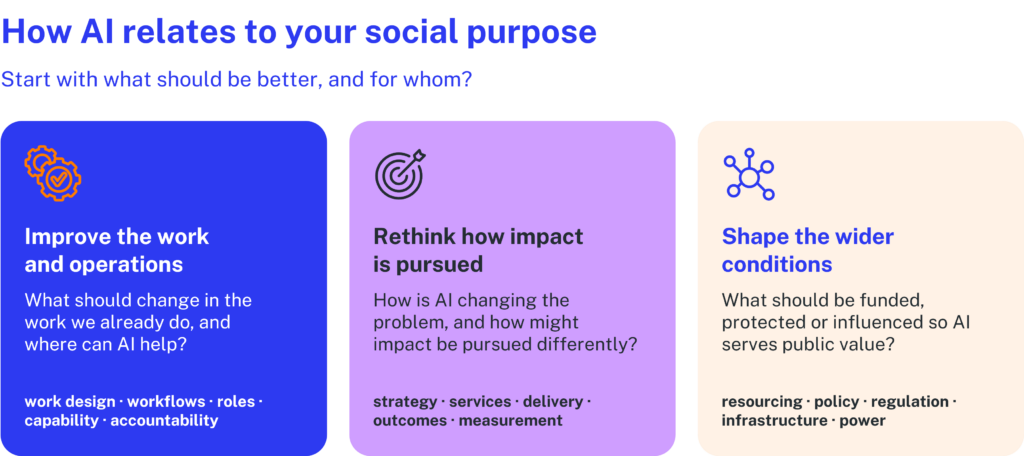
A useful way to widen the question is to look at three different areas of change: how work is done, how the mission is pursued, and the wider conditions in which organisations and communities act.
Improve the work
AI may improve quality, accessibility, staff experience, judgement, speed or cost. But the useful unit of analysis is the workflow, not the tool.
Consider case-note preparation in a community service. An AI-assisted draft might reduce administration, but minutes saved are not yet social value. Is the record accurate? Does checking it create new work? Is sensitive data protected? Do practitioners remain responsible for the client file? Most importantly, does the freed-up capacity return to relationships, judgement or service quality?
These questions move an organisation beyond distributing a product licence. They require choices about process, roles, evidence and accountability. Sometimes a simpler form, clearer guidance or changed staffing model will be the better answer.
Rethink how the mission is pursued
AI may enable new services, but it may also change the problems an organisation exists to address.
An employment organisation could use AI to support job seekers. It must also ask how automated recruitment, changing entry-level tasks and new employer expectations affect pathways into secure work. The response may involve practical AI guidance, employer transparency, redesigned training, worker voice or stronger human pathways through recruitment.
AI-supported translation or navigation may expand access. But if automation becomes the only realistic option for people with the least power, apparent efficiency may create a second-tier service. What can technology do well, where must a person remain accountable, and how can someone understand, question or contest an AI-influenced outcome?
At this level, AI may be part of the problem, part of the changing context, a possible response, or irrelevant to the best response. Starting with the mission keeps those possibilities open.
Shape the wider conditions
The third place to look is in the environment around your organisation: rules, funding practices, procurement, infrastructure, markets, public expectations and power.
These conditions are not neutral. A commissioner that adds extensive AI assurance requirements without resourcing smaller providers may increase inequality between organisations. A funder that encourages experimentation but funds only the technology, not data readiness, cybersecurity, staff learning, work redesign, community participation or evaluation, transfers much of the cost and risk downstream. A service system that quietly removes human channels may deepen digital exclusion and impose its largest burden on people who lack confidence or trust to interact with a machine when at their most vulnerable. Digital exclusion is not only about being offline. It can also mean being forced through a digital system that a person cannot meaningfully use, question or escape.
Some responses therefore belong to philanthropy, government, researchers, peak bodies, advocates and coalitions. They can support shared capability, fund independent evidence, strengthen worker and community voice, set procurement expectations, and shape policy, standards and public-interest uses.
This is not a linear maturity ladder. Moving from improving work to shaping wider conditions is not progress. The right emphasis depends on an institution’s purpose, materiality, capability, legitimacy and leverage.
Not every organisation has the same job
A local service provider, a national charity, a foundation and a government commissioner do not have the same agenda.
An operating organisation can redesign its work or services. A funder can resource capability and support safe, well-informed exploration, rather than prescribe adoption or leave organisations to experiment alone. That means funding the time, governance, infrastructure, learning and external support needed to discover where AI helps, where it does not and what responsible use requires. Government can consider how procurement, regulation and commissioning affect providers and the people they serve.
This produces a wider and more useful decision vocabulary: use it, redesign around it, build capability, set boundaries, fund it, shape it, monitor it, or choose to deliberately wait.
Deliberately waiting can be responsible when evidence, capability or permission to act is insufficient. Choosing not to use AI can also be legitimate, but it is not a complete strategy for an AI-shaped environment. Because make no mistake: AI is here to stay. It will affect individuals and institutions in more than one way, through the tools they choose, systems others operate, changes to work and shifts in public expectations. Neither waiting nor non-adoption removes the need to understand whether AI is already changing an organisation’s field, workforce or community.
Start with what should be better
The best entry point is not “Where can we use AI?”
Four questions can begin a more useful leadership, board, funding or commissioning discussion:
- What should be better for the people or mission we serve?
- Is AI part of the problem, part of the changing context, a possible response, or not material to the best response?
- Is the primary change in how we work, how we pursue impact, or the wider conditions around us?
- What is ours to do, what should we enable in others, and where should we collaborate, monitor, wait or decline?
The choices are not waiting for a future moment when the technology is finally “ready”. Vendors, employers, institutions and individuals are making them now. But the social sector should not let product cycles decide its priorities.
The bigger question is whether the sector can exercise enough judgement and agency to shape what AI means for the people and purposes it exists to serve.
At SVA, we are on the same journey, applying these questions to our own transformation as well as our work with the sector. We will test, learn and share what we can establish, while being clear about what remains uncertain.
We’d love to hear from you, to find out which questions your executive, workers, communities, funders and commissioners believe need deeper examination.
Why SVA created dedicated capability
SVA has decided these questions warrant dedicated attention, and so has created a Director, AI Enablement & Transformation role with a senior, organisation-wide remit. AI reaches beyond software procurement into strategy, organisational design, governance, workforce capability, service delivery, disadvantage and the systems in which social outcomes are pursued.
Creating the role is not proof that SVA has the answers. It is a commitment to do the work. Internally, we will experiment, redesign work, test new approaches, strengthen governance and build capability. Some things will work and some will not. Learning responsibly from both is how we can contribute more credibly than by offering opinions from the sidelines.
Externally, our aim is to connect changing technical capability with decisions facing charities, social enterprises, philanthropy and government. SVA’s work across disadvantage, employment, service systems, philanthropy and impact investing lets us examine who benefits, who carries risk and what must change for public value to be realised.
Some practical questions to test include: Can leaders make clearer choices without becoming technology companies? Can funders and commissioners see how their decisions shape others’ capability and burdens? Does change improve outcomes without sacrificing dignity, agency, trust, accountability or access to a person when it matters?
Please get in touch today
Written by

Share this article


Copied to clipboard


First Nations peoples should be aware that this website may contain the images, voices or names of people who have passed away.