
Revenue diversification: Start with strategy, your funding options will follow
Diversifying income streams can help reduce your organisation’s reliance on any single source of income, but it is not an end in and of itself. Avoid the pitfalls with these three core principles.
- News
 6 min read

Revenue diversification has become one of the defining strategic challenges facing Australia’s non-profit sector. With government grants becoming more competitive, philanthropic funding constrained, and delivery costs rising, many organisations are looking to reduce their reliance on a single source of income and explore new revenue streams.
However, the search for new funding can lead organisations to start in the wrong place. Before asking where the next dollar might come from, boards and executive teams should start with the question: what are we actually trying to achieve?
At SVA, we view revenue diversification not as a cash-generation exercise, but as a strategic tool to build a resilient, adaptable organisation. Executed with clarity, diversification unlocks financial autonomy and expands your organisation’s impact. Pursued reactively, it can lead to mission drift, operational friction, and expensive distractions. The critical choice for non-profit leaders isn’t whether to diversify – it is how to do it strategically.
The funding landscape for Australian charities
Australian charities generated approximately $222 billion in revenue in 2023, with government grants accounting for nearly half and goods or services contributing roughly one-third.1 Notably, funding models diverge sharply by scale: smaller non-profits rely heavily on philanthropy and donations, whereas larger organisations draw significantly higher shares from trading activities and fee-for-service delivery.
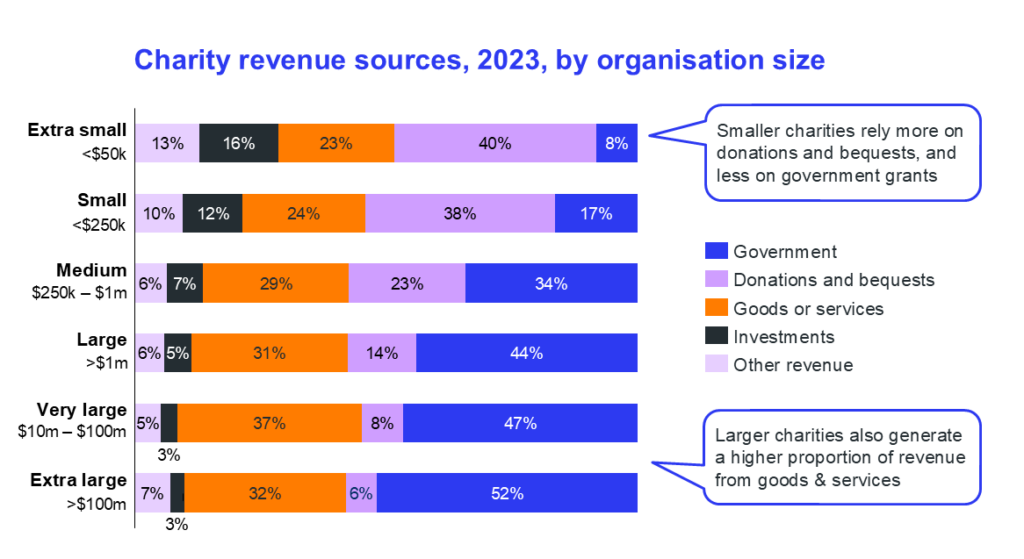
ACNC’s Australian Charities Report 11th Edition, 2025.
This concentration creates structural risk across the board. A major grant can end abruptly, policy shifts can reshape government funding, or economic headwinds can contract donor giving.
Diversification can help reduce reliance on any single source of income, but is not an end in and of itself. From our experience over 20 years advising non-profits and social impact organisations across Australia, diversification is most effective when it serves a clear strategy and strengthens an organisation’s ability to deliver on its purpose.
While every organisation’s circumstances differ, here are three core principles we have discovered through our cross-sector work that can help organisations navigate revenue diversification successfully.
Principle 1: Start with objectives, not opportunities
Many revenue diversification efforts begin with a creative brainstorming session about new funding streams. But starting with opportunities rather than objectives can quickly lead teams down the wrong path. Before asking where new revenue might come from, executive teams and boards should first ask: what are you trying to achieve, and what trade-offs are you willing to accept?
In our experience, the most successful diversification efforts begin with clarity on four foundational pillars:
- Objectives: Clarify your primary motivation. Are you seeking surplus funds, unrestricted income, long-term financial stability, or are you looking to extend your impact through a new or expanded program?
- Guardrails: Define your non-negotiables early. What core values must be protected, how much mission drift is unacceptable, and which options are out of scope?
- Risk Appetite: Clarify your tolerance for failure. How much financial capital or reputational exposure can you safely absorb?
- Capacity: Be realistic about execution capacity. What dedicated leadership bandwidth, specialist skill sets, and operational time can you commit?
Not every diversification strategy is right for every organisation. Scale, capability and capacity determine your options. If you are a smaller organisation, your capacity for business development and risk appetite may be constrained. Knowing your organisation’s operational bandwidth early prevents you from chasing opportunities that require more execution muscle than you may have built.
The hidden cost of ambiguity Without explicit alignment across these four pillars, decision-making stalls. SVA supported a homelessness service that repeatedly struggled because key stakeholders could not agree on whether their primary goal was maximising surplus or deepening social impact. Constantly shifting between competing motives generated friction and delayed action – ultimately preventing any surplus-generating initiatives from being launched. Establishing strategic alignment up front is a prerequisite.
Principle 2: Find the sweet spot: fit, effort and return
The social sector does not suffer from a shortage of ideas for revenue diversification. Organisations frequently explore fee-for-service offerings such as advisory and training services, membership models, licensing arrangements, and social enterprise ventures. Others look toward philanthropic fundraising, strategic mergers, or social finance instruments.
The real challenge is filtering for ideas worth pursuing: identifying options that deliver a return without consuming significant leadership bandwidth or diluting core operations. In our experience, the opportunities that tend to stand up to scrutiny balance four criteria. They:
- Align strongly with the organisational purpose
- Build on existing strengths and capabilities
- Deliver a return that justifies the required effort and risk
- Protect core focus and capacity (i.e., they can be implemented without drawing disproportionate attention away from core work).
Ideas that fail these tests often take up valuable leadership bandwidth without delivering tangible outcomes. Navigating this principle is an exercise in managing key strategic trade-offs. How an organisation resolves these trade-offs determines its final path. We’ve seen these four criteria play out with our clients.
1. Align strongly with organisational purpose
Higher margins are not always the right choice. When an employment services organisation evaluated commercial streams, potential profits were appealing. However, because commercial incentives threatened to dilute their specialised advocacy focus, they deliberately selected a lower-margin, mission-aligned grant instead. True prioritisation means choosing options that reinforce your core purpose – not just your surplus.
2. Build on existing strengths and capabilities
Revenue growth doesn’t always require launching entirely new services; sometimes it means fixing existing ones. A community transport organisation suffered from stagnant membership revenue and declining engagement. By overhauling their pricing structure while sharpening their core member value proposition, they simultaneously boosted revenue and deepened member commitment
3. Deliver a return that justifies the required effort and risk
Moving into commercial revenue can feel financially risky for fully grant-funded non-profits. A regional family violence service bridged this gap by securing philanthropic backing specifically to seed-fund and pilot a new, impactful program with a fee-for-service. This approach unlocked their first-ever philanthropic revenue stream while allowing them to safely test long-term commercial viability.
4. Protect core focus and capacity
Generating new income shouldn’t mean turning away the people who need you most. When a regional women’s health service evaluated fee-for-service options to reduce grant reliance, they designed a modest, two-tier client pricing model with explicit equity safeguards. The initiative has the potential to generate $10,000-$45,000 in annual unrestricted revenue and reduced appointment no-shows, all while preserving care access for vulnerable women.
Principle 3: Be realistic about the numbers
When evaluating business cases for big ideas such as new fee-for service offerings or entering an adjacent market, we often observe major optimism bias. Sector research shows that only 23% of Australian social enterprises cover their full costs through traded revenue alone – the remaining 77% rely on cross-subsidisation or non-traded revenue to stay viable.2
If your projected margins look too good to be true, they probably are. Ensure to account for true indirect and overhead costs, management oversight and realistic payback timelines:
- Factor in true indirect and overhead costs: Sector data shows indirect and overhead costs typically range from 26% to 47% (averaging 33%). Omitting shared overheads creates a false sense of profitability.3
- Value senior leadership bandwidth: Building new revenue streams demands significant executive time and specialised capability that must be accounted for.
- Plan for multi-year returns: Establishing a new business takes time; returns rarely materialise immediately.
The value of knowing when to stop A business case does not just validate expansion, it can also provide the evidence needed to exit unviable initiatives. An urban alcohol and other drugs service operated a training arm that was consistently running at a loss. SVA’s financial analysis revealed unsustainable margins that would require years of heavy capital investment to fix. Recognising the unlikelihood of profitability, leadership made the deliberate choice to close the training arm – avoiding three years of projected financial losses and redirecting critical resources back to core programs.
Closing out an underperforming initiative is just as valuable to organisational resilience as launching a successful new one.
Why strategy must guide diversification
There are no silver bullets when it comes to revenue diversification. No hidden pools of funding waiting to be discovered, and no single revenue stream that guarantees long-term sustainability. Every source of income, whether government, philanthropy, fee-for-service or commercial activity, requires investment, capability and ongoing effort.
Building a resilient, financially sustainable organisation doesn’t happen by accident, and rarely overnight. By grounding your revenue diversification strategy in clear objectives, making deliberate choices around trade-offs, and staying grounded in financial reality, you can navigate opportunities with clarity and focus.
Ultimately, revenue diversification isn’t about chasing every new dollar. It’s about making deliberate choices that strengthen your mission, build organisational resilience and support long-term social impact.
Notes
1 ACNC, Australian Charities Report 11th Edition, ACNC, 2025, accessed 2 Sept 2026.
2 Social Traders, Report on Identified Social Enterprises (RISE), Social Traders, 2024, accessed 2 Sept 2026.
3 SVA, Paying what it takes, SVA, 2022, accessed 2 Sept 2026.
Written by

Contributor

Contributor

Contributor

Share this article


Copied to clipboard

Get in touch
If you’d like to discuss diversifying your revenue, get in contact.
Related information





First Nations peoples should be aware that this website may contain the images, voices or names of people who have passed away.