
Navigating the alignment of the care economy
Australia's care and support system is undergoing a gradual yet structural shift, and disability and aged care providers that recognise the shift early will be best placed to respond.
- News
 6 min read

For decades, Australia’s care and support system has operated through separate sectors including disability, aged care, veterans’ care and other support services. Each was designed with a specific purpose and has evolved with its own objectives, funding arrangements, regulatory requirements and workforce structures.
In recent years, we have seen governments ask the question: where do these sectors overlap, and could greater alignment improve participant outcomes while reducing complexity for providers and workers?
The result is the gradual emergence of plans for a more aligned care economy. For disability and aged care service providers, this shift has the potential to reshape organisational strategy, service delivery models and workforce planning.
The USB-C transition for the care economy
A useful way to think about this shift is through the USB-C transition. Before USB-C, we had many devices that all needed power, such as phones, laptops and headphones but to our frustration often needed different types of charging cables.
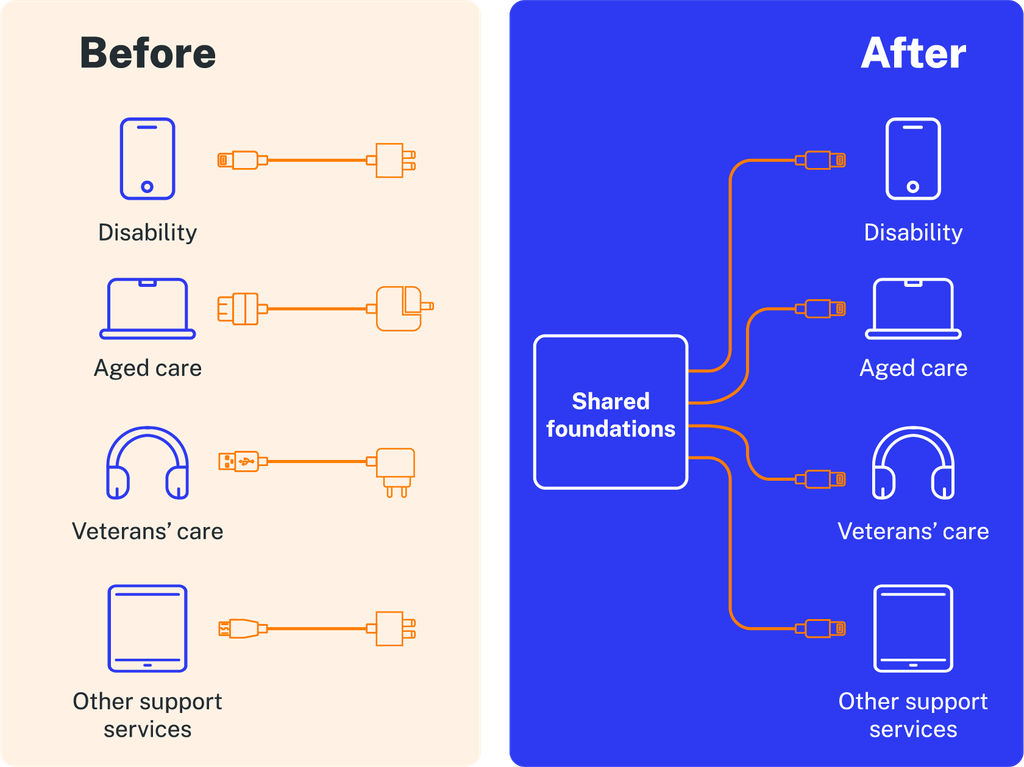
Today, while the devices have maintained their original purpose, most have moved to USB-C. The underlying foundation that enables them to function has become more consistent, eliminating the need for multiple cables and making the user experience more seamless.
Australia’s care economy is gradually going through a similar change. Different sectors will continue to serve different needs but governments are increasingly exploring whether the functions these sectors share, such as worker standards, registration requirements, and quality and safeguarding arrangements, could become more consistent. In other words, the standardisation of some of the underlying foundations of the care economy may be on the horizon.
Why alignment is gaining momentum
Two system-wide pressures are driving the need for greater alignment across the care economy.
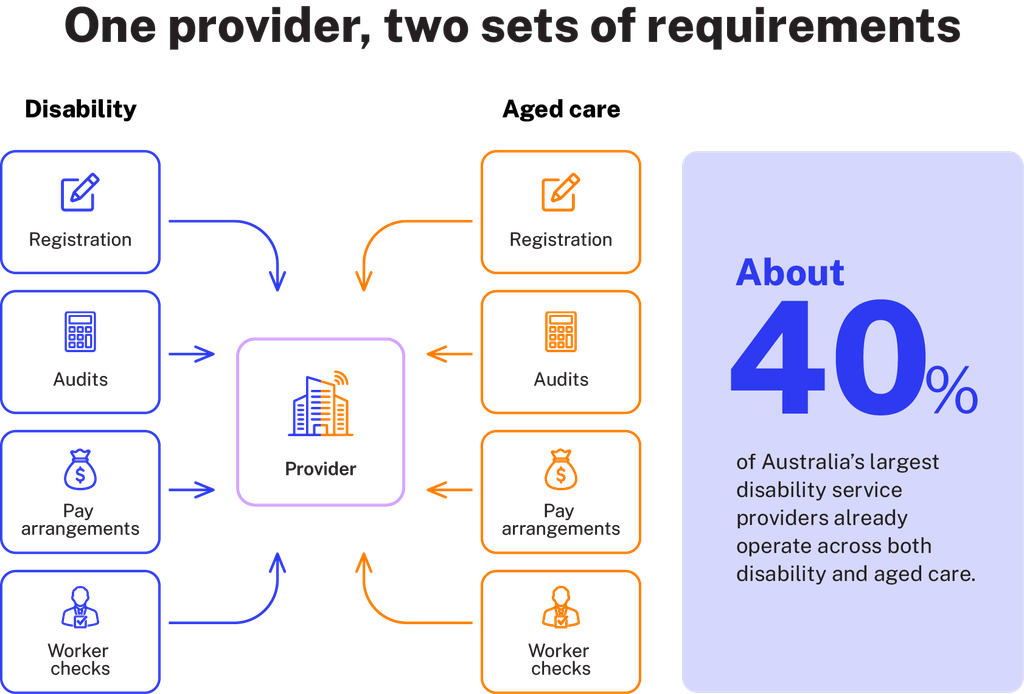
- Providers already operate across sectors: Approximately 40% of Australia’s largest disability service providers1 already operate across both disability and aged care. This makes sense because many core services, such as assistance with daily living and personal care, share common features across sectors. Yet a provider delivering the same supports to a NDIS participant and an aged care recipient will need to navigate separate registration systems, comply with separate audit processes, manage differing pay arrangements, and ensure staff hold multiple, overlapping worker checks. This duplication consumes time, money and effort that could otherwise be directed towards supporting people. Alignment has the potential to reduce this administrative burden.
- Productivity matters more than ever: Australia faces a significant demographic challenge. Demand for care services is growing as the population ages and support needs become more complex. At the same time, governments are managing financial pressures on the NDIS, with the scheme’s expense growing by 10.5% for the 12 months to June 2026.2 The question is: how can Australia meet growing demand without unsustainable increases in cost? Aligning common functions across care sectors and reducing duplication becomes increasingly attractive as governments search for productivity gains.
The reforms pointing in the same direction
Developments over recent years point to a clear trajectory toward greater alignment in areas of shared function. The following timeline highlights key developments shaping a more coordinated, system-wide approach to care.
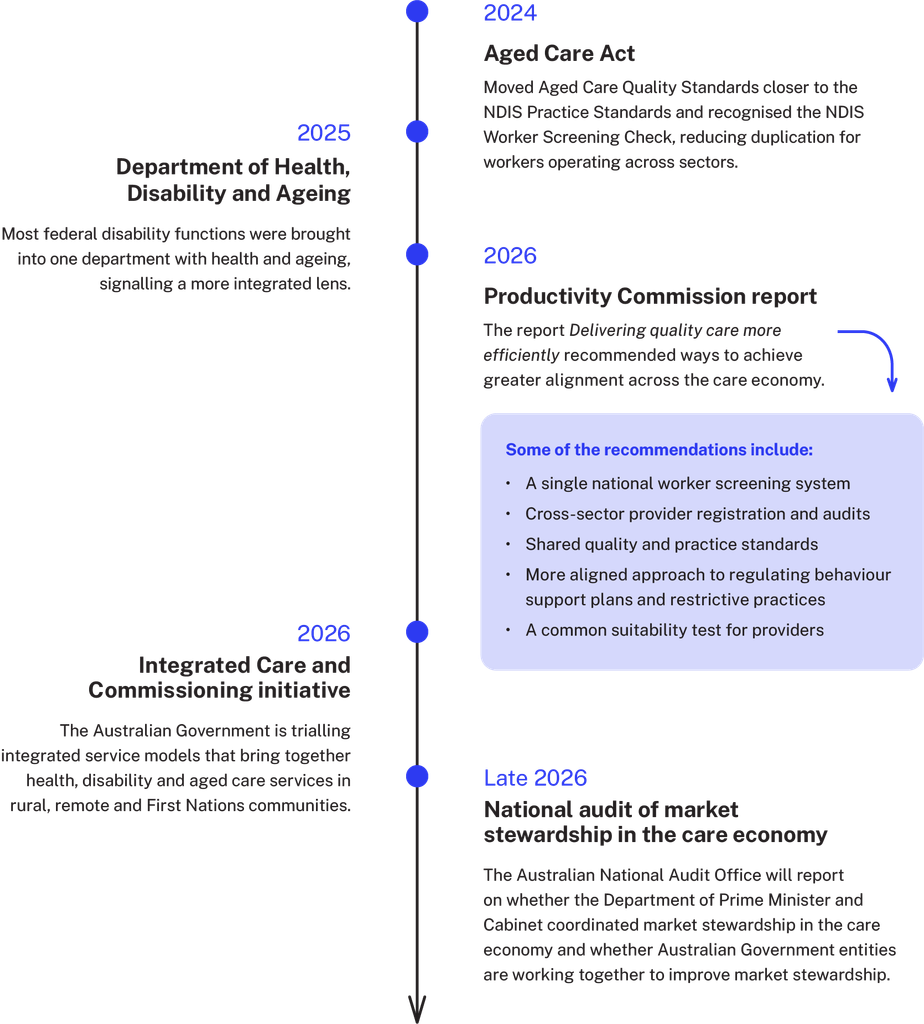
While the pace and scope of reform will ultimately depend on future policy decisions, the direction of travel is increasingly clear. There is growing interest in building more consistent foundations across the care economy, particularly in areas such as workforce regulation and quality and safeguarding.
Strategic implications: Opportunities and risks
For disability and aged care providers, alignment of the care economy presents both opportunities and risks. Organisations may benefit from reduced administrative burden, new growth opportunities and broader workforce pathways. However, they may also face increasing competition, workforce pressures and the challenge of navigating another period of reform.
Opportunities for providers
- More consistent compliance requirements could reduce duplicative administrative costs, especially for organisations expanding into or operating across multiple sectors.
- Consistent worker screening and regulatory oversight across sectors will strengthen safeguarding, making it more difficult for unsafe or unsuitable workers to move between sectors without detection, thereby improving participant safety.
- As barriers to entering adjacent sectors fall, disability providers may find it easier to move into areas like aged care or veterans’ care and vice versa. This may be especially true for providers with transferable capabilities and established infrastructure.
- Collaborative commissioning models may grow particularly in rural, remote and First Nations communities, where workforce shortages and service gaps demand greater coordination between organisations.
- Portability of worker screening and more consistent workforce requirements are likely to increase workforce mobility across sectors, bringing wider skills into the disability and aged care sectors and creating broader career pathways.
Risks for providers
- Adapting to new cross-sector systems, compliance requirements and workforce models may compound existing change fatigue, particularly given the cumulative impact of recent and ongoing reforms to the NDIS.
- Lower barriers will make it easier for external organisations to move into the disability or aged care market, intensifying competition.
- A more fluid care economy will drive stronger cross-sector competition for skilled workers, requiring intentional attraction and retention strategies.
Preparing for a more connected future
While the future model is still taking shape, there are some practical steps providers can start taking today.
- Understand the whole participant journey: Looking beyond a participant’s interaction with a single service often reveals duplicated processes and gaps between sectors. Understanding the broader journey can help providers identify where their organisation may be well placed to play a larger and more integrated role in supporting people across their full care experience, thereby improving participant outcomes.
- Incorporate cross-sector thinking into strategic planning: As alignment across the care economy continues to evolve, Boards and executive teams will need to move beyond monitoring developments within their own sector and take a broader view of emerging reforms, policy directions and innovation across the wider care economy. Providers should also examine where their current services, capabilities and infrastructure overlap with adjacent sectors, which may create natural opportunities for integration and expansion. Key strategic questions will include: ‘What role do we want to play in a more connected care system?’ and ‘Where can we create distinctive value across multiple sectors?’. Providers that view care economy alignment as a strategic issue will be better prepared to respond effectively and maintain their relevance in an evolving service landscape.
The 2024 merger between Berry Street and Yooralla highlights the value of cross-sector thinking. Berry Street provided family and community services expertise, while Yooralla brought experience in disability support. The merger was driven in part by the growing number of children entering care with disability and mental health needs, highlighting the increasing intersection between service systems. By bringing these capabilities together, the combined organisation is better positioned to deliver more integrated responses to complex challenges that sit across traditional service boundaries.
- Strengthen partnership capability: Providers wanting to participate in collaborative commissioning models will need to show that they can work effectively across organisational and sector boundaries. This requires building strong relationships with government agencies, health services, schools, community organisations and other social service providers. Providers will need to show they can deliver the core ingredients of a successful partnership: trust, clearly defined roles, shared outcomes, effective governance and robust approaches to data-sharing. Valuable lessons can be drawn from England’s Integrated Care Systems and Australia’s Aboriginal Community Controlled Health Organisations, both of which have experience pooling funds, coordinating multidisciplinary teams, and delivering supports that focus on the whole person. This capability will become even more important as initiatives such as Thriving Kids continue to develop and mature. Providers that can work seamlessly across health, education, community and disability settings will be better placed to take part in these new opportunities and deliver more coordinated support for children and families.
- Support a multi-skilled workforce: As workforce mobility increases, providers are likely to see a growing number of employees with hybrid skillsets and experience spanning multiple sectors. While specialist disability or aged care expertise will remain essential, there will be increasing value in capabilities that are transferable across settings such as trauma-informed care and multidisciplinary collaboration. Providers should consider how they can recognise and leverage these broader capabilities. Organisations that recognise hybrid skillsets, create opportunities to build transferable skills and offer long-term career pathways will be better placed to attract and retain talent in a more connected care economy.
Australia’s care economy is gradually moving towards greater consistency in the foundations that underpin care delivery, such as workforce requirements, quality standards, and provider registrations.
Just as the USB-C transition reduced unnecessary complexity and created a more seamless user experience, greater alignment across disability, aged care and other care sectors could enable providers to operate through more compatible shared functions. Over time, this could reduce administrative burden, support more integrated service delivery, and make it easier and more efficient to deliver services within the care economy.
While most of us cannot control exactly how these reforms unfold, providers can control how prepared they are. Providers that understand the complete participant journey, think strategically about their role in the system, build strong partnerships, and invest proactively in a multi-skilled workforce will be best positioned to thrive in an increasingly connected care economy.





Contact the authors
If you’re interested in finding out more about the ongoing alignment of the care economy, contact Angela Poon or Sam Thorp in our consulting team.


First Nations peoples should be aware that this website may contain the images, voices or names of people who have passed away.