
Funding the backbone
Driving sustainable change in northern Australia
- News
 5 min read
First published in The Mandarin, 22 June 2026
Anyone who lives and works in the Northern Territory knows that delivering services here is different.
The vast distances, jurisdictional overlaps, and remote realities require deep local knowledge for impact to be meaningful and lasting.
An evolution is underway in how we design programs and measure success in the NT, with the government and Aboriginal Community Controlled Organisations (ACCOs) working together more than ever before. But as ACCOs take on larger service delivery contracts than they realistically have operational and long-term funding to sustain, we are also seeing more waste, more confusion, and more delays in building strong and thriving communities in the NT.
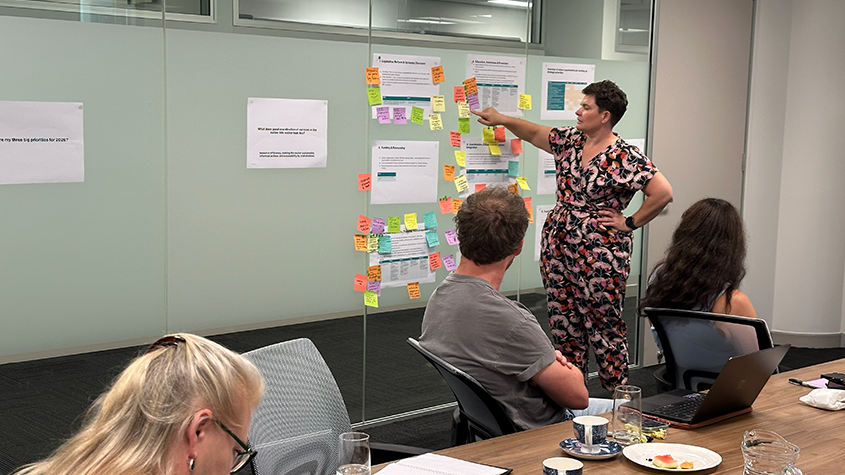
As someone who grew up in Alice Springs, is raising a family in Darwin, and has worked across the NT and Federal governments, directly with ACCOs, and now as a social impact consultant with SVA, I’ve seen the same story play out many times.
Programs meant to improve access to healthcare or lift outcomes for kids at school are announced with a big splash. But by the time they reach places like Groote Eylandt or central Australia, they often result in fragmented service delivery, duplication of effort, and ultimately, a failure to shift the dial on key outcomes.
The root cause? There’s a structural flaw in how these services are funded.
Governments and philanthropic funders are willing to pay for frontline service delivery, but not the organisational ‘backbone’ that makes any service sustainable. Without this foundation, even well-resourced programs collapse, and the myth that there’s more than enough funding for services in the Territory distracts from this deeper truth.
A layered and complex services ecosystem
Many people look at our small population and assume we have a small, unsophisticated government. But the NT has a higher density of public servants per capita than Canberra.
Government is a central system player.
If you want to make an impact in the NT, the government must be part of the work. However, I don’t think it’s any secret that the high density of government actors also creates complexity on the ground. Our current work with the Warnumumalya Health Services Aboriginal Corporation on Groote Eylandt is an example.
In a remote community of just over a few thousand people, we have the NT Department of Health running four clinics. At the same time, the NT Departments of Health and Education are funded to act as the backbone for Connected Beginnings (a federally funded program), running separate health programs as part of this. Alongside that, you have federal actors like the National Indigenous Australians Agency (NIAA) and the local government also running health programs.
The challenge is that coordination between these groups is highly fragmented. If you don’t understand that level of fragmentation – and the fatigue communities experience trying to navigate all those different players – you can’t effectively support them in addressing the underlying challenges.
Building a stronger backbone
There is a narrative that the territory is awash with cash. It’s not just false, it is systemically damaging. It stymies real progress by masking a deep, structural deficit in how funding is deployed.
To understand the current problems in service delivery, we must look at history.
Over the past two decades, the Aboriginal community-controlled sector has been progressively hollowed out. The Northern Territory Emergency Response (the Intervention) displaced local leadership; the abolition of the Community Development Employment Projects (CDEP) program stripped away local economic drivers; and the amalgamation of community councils into mega-shires moved assets and decision making power far away from local communities.
Now, driven by the National Agreement on Closing the Gap, government and philanthropy are pivoting heavily, increasingly expecting ACCOs to step up and deliver complex social services. But there is a flaw in this pivot: funders are only willing to pay for frontline service delivery. They are deeply reluctant to spend the time or money building the foundational organisational capacity required to make these ACCOs sustainable.
The reality is there isn’t enough money in the system to create long-term impact. We are expecting local organisations to deliver multi-million-dollar government contracts with the administrative resources and maturity of a local football committee. They are being set up to fail because the service is funded before the operational backbone – the governance structures, human resources, IT systems, and strategic planning – is in place.

What we frequently end up with is capital expenditure without operational expenditure; ‘white elephant’ infrastructure where clinics or facilities sit empty because no one secured the long-term, flexible funding to staff and manage them.
This waste isn’t just physical; it is programmatic and relational.
ACCOs pour immense cultural time, organisational energy, and hard-won community trust into standing up new services. When those programs inevitably struggle due to a lack of foundational support, the government’s response is rarely to help build that capacity. Instead, they often simply pivot the contract to another provider, abandoning the organisation’s heavy relational investment and starting the exhausting cycle all over again.
It’s time for a shift. When we spend money on a solution, we need to ensure the funding is helping local organisations stand on their own two feet.
We saw what is possible through our work with Aboriginal Housing NT (AHNT). By partnering with them to help build their organisational muscle, AHNT was empowered to stand strong as an independent peak body. They have since worked closely with the community to shape systemic policy, including successfully advocating against the Remote Rent Framework, protecting thousands of First Nations tenants from unfair rent increases.
An evolution underway
Setting policies and change programs up for success means translating national best practices through the lens of community, place, and partnership. To do impactful work up here, you need to build relationships, understand the complexity of culture and government, and accept that it takes time for communities to develop truly self determined priorities and projects.
ACCOs will be key to achieving Aboriginal self-determination and to improving outcomes for Territorians across the early years, education, housing and employment.
The message for government and philanthropic funders is clear: we must stop funding isolated programs and start funding foundational capacity. It’s time to trust that local organisations, and ACCOs in particular, know what is right for their people, and to resource them properly so they can lead the way.

Renee de Jong is Director of Consulting at SVA
Based in Darwin, Renee works with social sector organisations on strategic planning, program and policy design, capacity building, and outcomes management and evaluation.
SVA has operated in northern Australia for over a decade. Current work includes supporting the Warnumamalya Health Services Aboriginal Corporation on Groote Eylandt, working with Aboriginal Investment NT to design the frameworks needed to deliver impact for Aboriginal Territorians, and building the organisational foundations of ACCOs across the Territory.
Contact Renee and her team
Written by

Share this article


Copied to clipboard
Related information



First Nations peoples should be aware that this website may contain the images, voices or names of people who have passed away.