
Why libraries are good for us
Public libraries are more than books and mortar; they provide opportunities for valued social connection. We recently worked with the State Library Victoria bringing together the evidence base to demonstrate the significant impact these vital community hubs deliver in combatting loneliness.
- News
 4 min read

When Terri arrived in Australia from Korea in 2022, she stepped straight into COVID lockdown.
Her grasp of English was hesitant. Alone in a new country, social isolation set in. Until she found State Library Victoria’s COVID Conversation Club. Week by week, Terri sat online, in a circle of strangers who soon became her community. They shared stories and built trust. The club gave her more than words or phrases; it gave her social connection.
The World Health Organization ranks social connection alongside physical and mental health as a core pillar of wellbeing. Its 2025 report sounds the alarm: loneliness fuels depression, anxiety and premature death. Globally, one in six people feel lonely.1 In Australia, it’s nearly one in three.2
That’s millions of Australians missing the relationships and opportunities for social connection that help them flourish.
What’s more, loneliness doesn’t just hurt – it costs. Social isolation pushes up healthcare bills, pulls people out of the workforce and weakens the networks that hold communities together.3 Australia spends an estimated $2.7 billion addressing the issue each year.4
Terri’s story is proof.
In a world where loneliness is rising, libraries connect people to learning, to services, and to each other.
Unfortunately, as is the case with many public services, libraries are under constant pressure to prove their value; to justify ongoing funding commitments and advocate for resources that would allow them to do even more.
Public libraries have a unique opportunity to position themselves as inclusive and accessible hubs of connection and advocate more strongly for their work in this area.
In support of this, we worked with State Library Victoria and its broader network, to document the contribution of Victorian public libraries in building social connection and to develop tools to demonstrate their impact.
The resulting report and measurement toolkit draws on existing literature, case studies from public libraries and new input from key stakeholders.
Libraries drive connection and improve wellbeing
Libraries offer more than books. They are a key element of social infrastructure, offering support and community.
Research shows that visiting a library can lift mood and wellbeing.5
As one library participant shared,
“When you come here it’s not just about doing art and learning something, it’s about being with other people and socialising.6
Between mid-2024 to mid-2025, more than 24 million visits were made to Victorian libraries. These libraries delivered over 112,597 programs: in-person, online, and in hybrid formats.7 Many programs focus on reading. Others teach digital skills or provide self-development opportunities, like Terri’s group. One thing is constant; every program helps people connect.
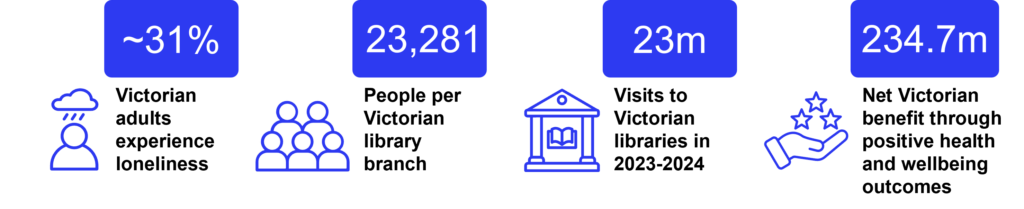
Analysis has found that investing in public libraries generates a positive social return on investment by creating value for communities, improving the subjective health and wellbeing of Victorian adults engaging with them by 8%.8
Every dollar invested returns almost two in benefit. In just one year, Victorian libraries delivered over $234 million in health and wellbeing value.9 That’s impact.
Developing a shared language and an adaptable toolkit
In the project, we brought together the existing evidence to support public libraries to tell this important story and created flexible tools to measure and articulate this impact.
To achieve this we documented the collective contribution made by pubic libraries across Victoria that actively supports social connection. This involved capturing work that traditionally hadn’t been framed as social connection. This included identifying the scale of the initiatives – the number of programs etc as well as a base of case studies – stories of what they do.
We found that libraries nurture social connection through four core activities:
- Places: Libraries offer free, safe, inclusive spaces, both physical and digital, where people can gather, spend time and connect to each other.
- Programs: Libraries run diverse, inclusive programs and activities that bring people together, provide opportunities for social connection, and support lifelong learning.
- People: Library staff play a vital role in fostering connection through respectful, whole-person-centred services.
- Partnerships: Libraries work with other organisations to extend their reach and respond to community needs.
We then developed a shared language and the beginnings of an evidence base to help librarians articulate how libraries are contributing to social connection. The resulting adaptable toolkit can be used by individual libraries to build their own evidence base, while also being leveraged to provide broader sector-wide evidence.
Measuring social value to advocate for funding
Understanding and measuring social value helps ensure that decision-making goes beyond simple financial metrics to capture the outcomes and benefits that are most valued by individuals and communities.
Libraries can build on the existing evidence base by collecting their own data on the impact and social value of their work to nurture social connection in their communities.
This report recommends two strategic next steps to capture and communicate impact:
- Adopting the Public Library Toolkit: Using the practical tools, public libraries can gather and share data to understand and demonstrate their impact. The toolkit doesn’t require specialist training and is designed to be flexible and practical for busy teams.
- Exploring statewide measurement: Collaborating to measure and demonstrate the impact of statewide activities possibly core programs like Story Time or the Home Library Service. This approach is targeted at State Library Victoria and Public Libraries Victoria in their role providing leadership and oversight of the sector as a whole.
The final report and toolkit serve as a valuable asset enabling both individual libaries and the broader sector to advocate for improved funding, partnerships and recognition.
The report, Public libraries for social connection, was launched at the Australian Library and Information Association’s National Conference in May 2026.
Notes
1 World Health Organisation (WHO), From loneliness to social connection – charting a path to healthier societies, WHO Commission on Social Connection, Geneva, [report], 2025, page xvi, ISBN 978-92-4-011236-0, accessed 10 October 2025.
2 Ending Loneliness Together, State of the Nation Report- Social Connection in Australia, Ending Loneliness Together [website], 2023, page 12, accessed 10 October 2025.
3 World Health Organisation (WHO), From loneliness to social connection – charting a path to healthier societies, WHO Commission on Social Connection, Geneva, [report], 2025, page 95, ISBN 978-92-4-011236-0, accessed 10 October 2025.
4 Duncan A, Kiely D, Mavisakalyan A, Peters A, Seymour R, Twomey C, Vu L, Stronger together: loneliness and social connectedness in Australia, Bankwest Curtin Economics Centre, [report], 2021, page 157, accessed, 4 November 2025.
5 SGS Economics and Planning, The health and wellbeing benefits of public libraries across Victoria, SGS Economics and Planning, [report], 2023, page 41, accessed 10 October 2025.
6 SGS Economics and Planning, The health and wellbeing benefits of public libraries across Victoria, SGS Economics and Planning, [report], 2023, page 19, accessed 16 June 2025.
7 I&J Management Services, 2024-2025 PLV Statistical Survey Summary Report, Public Libraries Victoria, [report], 2025, page 26, accessed 10 October 2025.
8 SGS Economics and Planning, The health and wellbeing benefits of public libraries across Victoria, SGS Economics and Planning, [report], 2023, page 41, accessed 10 October 2025.
9 SGS Economics and Planning, Libraries work! The socioeconomic value of public libraries to Victorians, SGS Economics and Planning, [report], 2018, page 8, accessed 10 October 2025 and SGS Economics and Planning, The health and wellbeing benefits of public libraries across Victoria, SGS Economics and Planning, [report], 2023, page 41, accessed 10 October 2025.
Written by

Share this article


Copied to clipboard

Get in touch
Contact the consulting team to learn how we can support your organisation or program
Related information





First Nations peoples should be aware that this website may contain the images, voices or names of people who have passed away.