
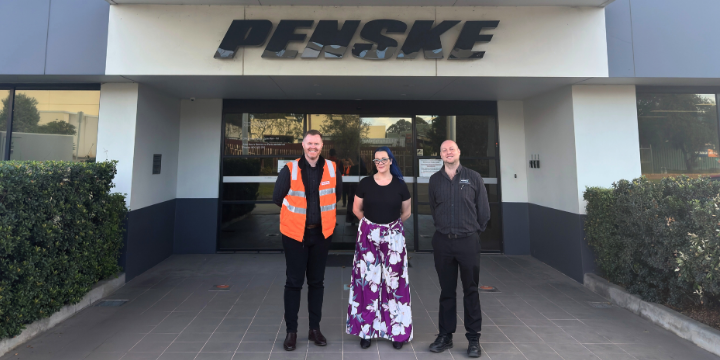
Penske’s Total Inclusion Pilot
Changing the apprenticeship experience for a stronger, more inclusive workforce.
- Case study
 3 min read
*The Employer Innovation Lab helps employers create pathways for young people without degrees, with support from the Paul Ramsay Foundation and the Macquarie Group Foundation.
With more than 1,300 employees, Penske Australia & New Zealand supplies trucks, engines and power systems to some of the region’s hardest-working industries, from mining and construction to agriculture, defence and marine.
In May 2024, Penske joined the Employer Innovation Lab in Western Sydney to broaden its talent pool and improve retention in response to skill shortages and succession planning. Two years and nine apprentices on, Penske says the ‘Total Inclusion Pilot’ helped sharpen its approach to recruitment, onboarding and apprentice support.
The business challenge
Sydney is a tough recruitment market, particularly for technical and trade roles. Penske’s ‘Total Inclusion Pilot’ was a response to skill shortages with targeted entry-level roles in Chipping Norton and West Sydney. The aim was to improve access for youth facing disadvantage. The business also needed to think differently about how it attracted and supported apprentices.
Initially, the broader team questioned the sudden emphasis on this issue, particularly regarding the apprentice cohort. In the aftermath, however, supervisors’ eyes have been opened. The old ‘when I was an apprentice’ mentality has shifted, recognising that the challenges faced by today’s apprentices are different.
Feedback also highlighted broader issues affecting apprentices. Through its employee engagement survey, Penske found that 1 in 8 people, especially within the apprentice cohort aged 17 to 35, had concerns about mental health – this broadened the business’s understanding of the range of concerns and challenges.
I believe our 2025 intake for first-year apprentices is our best ever, largely thanks to the work we’ve done with SVA.”Ben Holden • General Manager – Eastern Region, Penske Australia & New Zealand

Building the pilot
Penske revised recruitment materials to be more inclusive, reached out to local schools, and participated in Indigenous job drives. They provided community partners with specific details of their existing assessment so that the candidates could prepare ahead of the recruitment. This helped expand the candidate pool and make it more diverse. They also prepared the first career mapping for new recruits across the business.
SVA ran focus groups that provided Penske with direct feedback from young people in the business and helped streamline recruitment and strengthen support systems.
One major change was the reintroduction of Penske’s apprentice rotation strategy, which had been inactive for years. First, second and third-year apprentices now rotate monthly through different parts of the business, including rail, defence and data centre work. The aim is to broaden their experience and challenge their skill sets.
As part of its effort to strengthen support systems, Penske introduced monthly apprentice catchups, bringing apprentices together with leaders from within and outside the business to discuss career journeys and progression.
“Being a first-year apprentice can be overwhelming,” they explain, “so these sessions are valuable”.
The business changed how it communicated about mental health support, introducing new flyers, brochures, and cards with contact information for discreet, easy-to-access support services. Penske continues to reinforce resources through team communication and check-ins.
Since 2023, our business in Chipping Norton has quadrupled in size, and we need the technical talent to sustain the growth. The Employer Innovation Lab has helped us with our current structures, onboarding new staff, and refining our approach.”Sam Kelly • Senior Talent Acquisition Partner, Penske Australia & New Zealand
Key learnings and outcomes
For Penske, one of the most significant insights was understanding the challenges young people face in the labour market. “Working with the young consultants in the Lab’s workshops and in the workplace has made a huge difference,” reflects the team. “Participating in the pilot was a valuable opportunity for reflection. It highlighted the way we do things – and we think we do a better job now,” they add.
The size and strength of the latest intake are a testament to that progress. Penske recently hired four new first-year apprentices – the largest cohort ever at the Chipping Norton site, and the highest number across the business in a single year.
It has also been the most successful recruiting drive the Chipping Norton business has seen. In previous years, the intake had been smaller, and at times the business could not fill all available places. This time, Penske had to turn away quality candidates because the talent pool was so large and strong.
Penske also recognised the pilot’s broader benefits for the business. Their approach – regular check-ins and a focus on mental health, now part of BAU – not only impacts apprentices but also benefits- those conducting the check-ins and strengthens connections and team building across the wider team.
What’s next
At the time of the interview, nine apprentices were taking part in the rotation program. The plan is to continue a four-apprentice intake strategy to build a cohort of 16 apprentices progressing through the program. Rather than waiting for people who have already been trained, Penske is confident to grow their own talent. “This ‘grow-your-own’ approach is vital for our ongoing success,” says Regional Manager Ben Holden. “Now, when we find eager, talented individuals willing to learn new skills, we are confident our processes will support their growth and success.”
Key takeaways for employers
- Listen directly to young people in your workplace: Focus groups and apprentice feedback enabled Penske to rethink attraction, recruitment, communication, and support strategies.
- Support beyond hiring: Monthly apprentice catchups and regular check-ins made apprentices feel more supported during their first year.
- Test assumptions: The pilot helped supervisors move beyond stereotypes and outdated beliefs, allowing them to better meet the current needs of young hires.
- Small changes can be effective: Enhancing mental health resources, improving communication, and providing more direct support all strengthened the apprentice experience.
- Expose new hires to different parts of the business: Reintroducing job rotations allowed apprentices to gain experience across various functions and provided a clear pathway for future growth.
Meet the team
Get in touch to find out how the Employment team can help you create lasting change
-
 Director, Employment Lisa Fowkes
 -
 Associate Director, Employment Simon Crabb
 -
 Associate Director, Employment Johann Tabit
 -
 Associate Director, Employment Ronan Smyth
 -
 Employer Engagement Lead, Employment Susan Whillas
 -
 Employment Evidence and Practice Advisor Christine Han