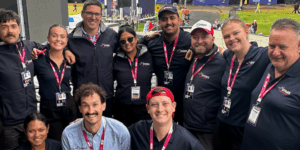

Opening doors to Victoria’s Big Build: how EBTA redesigned jobs to include young people with disability
Showcasing how flexibility creates opportunity.
- Case study
 4 min read
*The Employer Innovation Lab helps employers create pathways for young people without degrees, with support from the Paul Ramsay Foundation and the Macquarie Group Foundation. In 2024 SVA ran its first Employer Innovation Lab that focussed on helping employers design roles and entry pathways for young people with disability. The project was majority funded by the Australian Government through the Local Jobs Program and delivered in partnership with Children and Young People with Disability Australia (CYDA).
In the fast-paced world of infrastructure, roles are often rigid: experience is assumed, language is technical, and the path in can be narrow, especially for people who haven’t worked in the industry before. But one team is showing that small shifts can lead to real change. The Eastern Freeway Burke to Tram Alliance (EBTA) as part of the North East Link Program, operates a central logistics warehouse in Nunawading. In 2024, EBTA joined the Employer Innovation Lab to create more inclusive entry points for young people with disability.
The result was a new traineeship role built from the ground up, a new hire building confidence every week, and a broader shift in how EBTA thinks about inclusive employment.
The challenge: good intent, limited pathways
The team wanted to be more inclusive, however, like many in construction, didn’t know where to begin. Existing warehouse roles had become set in stone over time. There was a strong focus on prior experience, especially with “construction consumables” and other industry-specific knowledge. Internal champions were pushing for change, but there was also hesitation: could someone without a construction background succeed?
The YPWD Lab gave EBTA space to re-examine assumptions, and the practical support to build something different. “We used information from the pilot to build our internal pitch”, mentions the team. “The engagement with the youth consultants helped break down preconceived ideas about what young people with disability can do.”
The Lab helped us adapt our inclusive employment practices that were already in place.”Tara Dalgleish • Industry Capability & Inclusion Manager, EBTA

Designing a role from scratch
Working with SVA and CYDA, EBTA developed a traineeship for candidates with little to no industry experience. To design the role, the logistics and warehousing team broke down tasks based on complexity, sensory load and physical demand
This exercise also revealed there were operational efficiencies to be found. During the design process, these tasks were consolidated into the new position, combining warehousing and facilities support into one role.
The final position, Warehouse and Facilities Assistant (Traineeship) was intentionally designed to support learning over time.
Changing the recruitment process
Alongside the role redesign, EBTA made their recruitment process more accessible.
They filmed a “day in the life” video with the warehouse supervisor showing the role in action. An information session followed, giving candidates the chance to meet the team in a low-pressure setting. These changes helped candidates determine whether the role was a good fit before proceeding to formal interviews.
EBTA were supported to undertake strengths-based conversations about workplace adjustments – including any relevant prescription medications and possible accommodations. As a result, medical assessments, often a sticking point in construction, were explained in clear terms for candidates. Additionally, reference checks from employment partners were accepted. And onboarding (usually packed into one week), was spread across several weeks to give new starters time to settle in.
These were deliberate, small yet targeted shifts to make the process open to a broader pool of candidates.
The pilot has resulted in one new hire in 2025 with two further roles planned for the 2026. Before the new hire commenced the traineeship, EBTA completed CYDA’s disability awareness training and implemented a buddy system. The pilot’s employment partner APM, supported with regular check-ins.
The role’s supervision was set up to help learning on a day-to-day basis; one key approach was to introduce tasks gradually, thereby building confidence over time and matching tasks appropriately, making them incrementally more challenging.
Lessons learned
The pilot was used as an organisational ‘prompt’ for broader changes, helping the team adapt existing inclusive practices. Engagement with the pilot’s youth consultants helped challenge assumptions about what young people with disability can do. By the end of the pilot, managers reported feeling more confident navigating workplace adjustments.
Importantly, the changes have started to ripple beyond the project. EBTA is developing internal guidance and sharing learnings with parent companies Laing O’Rourke and Symal.
Key takeaways for employers
- Challenge your assumptions: Redesigning entry-level roles is an opportunity to rethink what’s ‘required’ and open doors to new talent.
- Rethink the role itself: Break down tasks by complexity, sensory load, and physical demand. This can reveal more flexible, inclusive ways to structure work.
- Look for hidden efficiencies: Redesigning tasks uncovered process improvements. It also freed up senior staff to focus on more skilled work by shifting lower-level tasks elsewhere.
- Change how you recruit: Use videos, visuals and clear information to help candidates understand the role and make informed choices.
- Support your frontline supervisors: Give them time, training, and support to adapt. They play a significant role in making inclusion work on a day-to-day basis.
- Take a long view: Inclusive recruitment is not a one-off; it grows through practice, reflection and small, consistent changes.
- Bring leadership in early: Get senior decision makers on board from the start. It helps move things faster and clears the path for approvals.
What’s next
The work enabled EBTA to put into practice organisational values around diversity and inclusion. This had the effect of increasing the efficiency of work practices and building a greater level of staff appreciation and maturity in their capacity to support a wider range of people.
EBTA are now planning two more roles using the same design and recruitment process. There’s also growing interest in applying the model to other parts of the business and are currently developing written guidance for their parent companies, Laing O’Rourke and Symal, to be used in future projects.
Hear directly from the EBTA team in this webinar, where they share their reflections, lessons and what’s next:
Meet the team
Get in touch to find out how the Employment team can help you create lasting change
-
 Director, Employment Lisa Fowkes
 -
 Associate Director, Employment Simon Crabb
 -
 Associate Director, Employment Johann Tabit
 -
 Associate Director, Employment Ronan Smyth
 -
 Employer Engagement Lead, Employment Susan Whillas
 -
 Employment Evidence and Practice Advisor Christine Han