
Beyond the Census: what data do you need to make your next big decision?
The 2026 Census will give us a comprehensive picture of Australia’s people and communities. Organisations that drive social impact rely on data like the Census to inform their strategies, business planning and decision making. However there are many other publicly available datasets enabling organisations to make better decisions about their strategies, services, workforces and funding needs.
- News
 4 min read

On Tuesday 11 August 2026, people across Australia took part in the Census of Population and Housing.
Held every five years by the Australian Bureau of Statistics, the Census provides a comprehensive snapshot of the country. It gives us consistent information about communities across the country: their ages, household structures, cultural backgrounds, education, employment, incomes, housing and need for assistance.
The data is available for geographic areas of all different sizes and types (including local government areas (LGAs), Indigenous geographies, postal areas, and more) which can be combined to build a picture of the specific communities an organisation serves.
This dataset, last gathered in 2021, is invaluable, but it won’t be available quickly. Most results from the 2026 Census will be released from June 2027, with further releases continuing into 2028.
The Census is a rich source of data for social impact organisations who are under increasing pressure to take a data-led approach to strategy, planning and understanding impact. Funders want to see tangible evidence of community need. But putting a pause on data-led work until the Census results are released isn’t an option.
This article sets out how organisations can combine existing and historical Census data with more frequently updated public data and their own organisational data to inform decision making.
Start with the decision, not the dataset
Census data can reveal a great deal about a community, but a demographic profile is rarely useful on its own.
Organisations should start with the decision they need to make, and then consider the data they need. For example:
- Are we meeting our community’s needs long-term?
- What do we need to change to do so? A new operating model? Different workforce set-up? An entirely new strategy?
- Is our funding pipeline strong enough to enable us to do this? If not, what do we need to demonstrate to make the case for additional funding?
Answering these questions usually requires much more than Census data alone – particularly considering community needs change quickly and the Census only takes place every five years. The strongest analysis combines relevant public datasets with an organisation’s own information, and the knowledge of staff and communities. The exact datasets used depend on the organisation’s context, the services they provide, and the sectors they work in.
The following three sections show how organisations have strategically pulled multiple data sources together to make more measurable decisions.
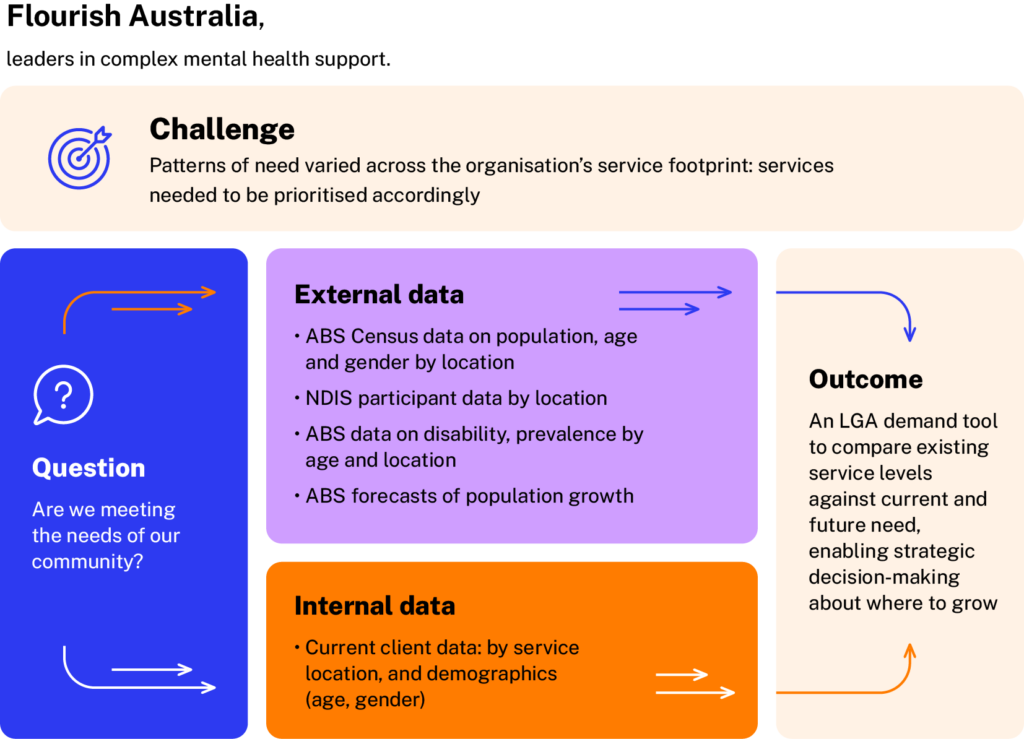
Are we meeting the needs of our community?
Flourish, a national mental health provider wanted to develop an LGA data visualisation that would help its leadership understand where current and potential beneficiaries were located, and how patterns of need varied across its service footprint.
To identify the highest priority LGAs, existing client locations were compared with projected demand. This required analysis of Census data alongside publicly available NDIS participant data, disability prevalence and local population growth. An added layer of depth was provided by building in comparison with client demographics.
By bringing all these data sources into one tool, leaders could interrogate key indicators at an LGA level and compare existing service reach with projected community need. Rather than prescribing where the provider should operate, it provided a clearer evidence base for strategic planning –helping the organisation identify areas of potential unmet need, test assumptions about its current footprint and prioritise where further analysis or investment may be required.
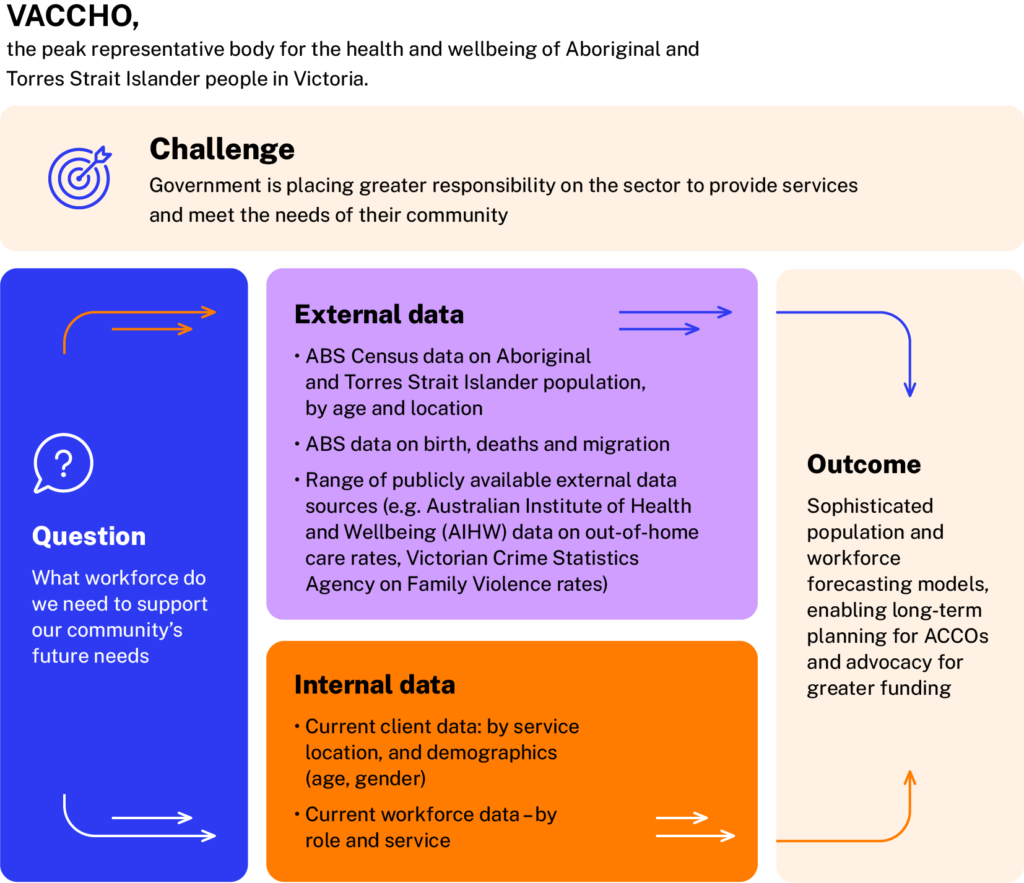
What workforce do we need to support our community’s future needs?
To support long-term social impact strategy and planning, the Victorian Aboriginal Community Controlled Health Organisation (VACCHO) needed to build a projection for Members of the workforce it may need to support Victoria’s First Nations community over the next 15 years.
Working with VACCHO and its Members, data from successive Censuses was used to understand historical population growth of key groups. This insight was further enhanced with additional data on births, deaths, migration, and indicators of future service demand from ABS and other publicly available datasets, and information from individual Aboriginal Community Controlled Organisations about their current clients, services and workforces. In addition, we considered an ‘unexplained growth’ factor, which captures the growth in First Nations population seen between Censuses that cannot be explained by the births, deaths and migration.i
The modelling projected that Victoria’s First Nations population could grow by 74% by 2037, and that workforce demand was projected to increase by between 90% and 150%.
The results have helped Members plan for future workforce and infrastructure requirements, giving them a data-backed reason to apply for growth funding and strengthen VACCHO’s advocacy to government.
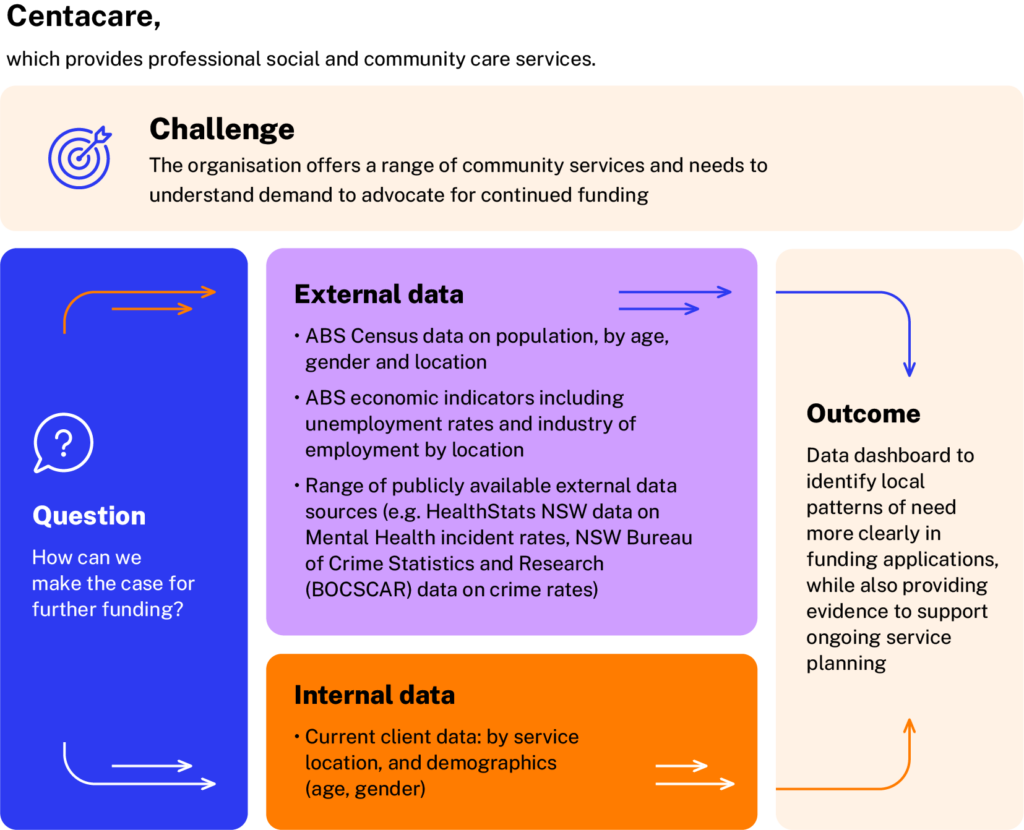
How can we make the case for further funding?
Centacare South West NSW supports individuals and families across the Riverina through a range of community services. To better understand the needs of its community, and support competitive tender applications, it needed to visualise indicators of community demand on one dashboard.
Using Census and other publicly available data from the ABS and other sources, demographic and socioeconomic indicators were mapped at the LGA level, including Aboriginal and Torres Strait Islander population, youth unemployment, homelessness, domestic violence, crime and mental health. This was then translated into tailored visualisations and mapping tools which presented relevant information in a format that could be easily viewed and used for decision-making by the Centacare team.
This has helped Centacare demonstrate local patterns of need more clearly in funding applications, while also providing evidence to support ongoing service planning.
Using Census data with care
Census data captures a point in time, but geographic boundaries may not match service catchments, and population indicators are not a direct measure of demand for a particular service.
Good analysis requires judgement, local context and engagement with the people and communities an organisation serves.
There are particular considerations when analysing First Nations population data. Aboriginal and Torres Strait Islander people have historically been undercounted in the Census: the ABS estimated a net undercount of 17.4% in 2021. Census counts should therefore be interpreted carefully, particularly for smaller regional and remote communities, and must be analysed alongside community knowledge and other publicly available sources of data if available.
What happens after Census night?
Organisations can use currently available information, while planning to revisit important assumptions as new data is released.
The ABS currently plans three main release phases:
- June 2027: Most topics will become available across nearly all geographic areas. These will include age, income, housing, long-term health conditions and Aboriginal and Torres Strait Islander origin.
- October 2027: Employment and location-related information released, including occupation, industry, qualifications, and workplace location
- Early to mid-2028: More complex outputs will be released, including the updated Socio-Economic Indexes for Areas, estimates of homelessness and distance travelled to work. 2027 data releases are also updated with refined figures.
The opportunity is to use the best available evidence now, identify which strategies and plans will benefit from refreshed data, and revisit them as the right information becomes available.
Where could data better support your organisation to build strategies, make decisions and understand impact? Do you need help working out what data to use?
Written by

Share this article


Copied to clipboard

Get in touch
If you’d like to find out how we could support you with your data needs, contact us.
Related information





First Nations peoples should be aware that this website may contain the images, voices or names of people who have passed away.